 EconoVue™EconoVue™
Moneyball: How predictive analytics accelerates business engagement for Workforce Development Boards
– by Danny Patterson
As the baseball season kicks off, I realize that WDBs can learn a lot from baseball and their Moneyball approach. This approach is a classic example of predictive analytics in action. Let me explain.
In the old days of baseball, scouts focused on the usual statistics—batting average, RBIs, stolen bases, and their utility in the field. However, that all changed with the Moneyball approach made famous by the Oakland A’s and their general manager Billy Beane in 2002.
The premise behind the Moneyball theory is still player analytics. But it only considers two key data points – a player’s batting average and their on-base percentage – as predictors of their true potential for winning baseball games. Essentially, Can a player hit to get on base and create runs? After losing some star players, Beane’s team-building approach changed the whole game. It also led to a 20-game winning streak (2nd longest in the modern era) and clinched the American League West playoffs. Today, most teams leverage predictive analytics in the same way to fuel their winning strategies.
So, what can WDBs learn from this? We know analyzing data is nothing new to WDBs. They still look to answer these fundamental questions – Who is looking for a job? Who is hiring? Is there a skills match? However, it is a game-changer for those who leverage the power of predictive analytics for accelerating business engagement. Surprisingly, however, WDBs often do not understand the importance of or do not have the data to identify healthy and growing businesses in the hiring equation. Business health is as vital to job quality as an on-base percentage is to scoring runs. Both are winning formulas.
Adopting predictive analytics requires a mind shift that leads to improved performance. By using three simple strategies, WDBs/OneStop Operators can:
As in baseball, a team needs the ability to predict a player’s batting average. Target the ball with greater precision and speed to increase on-base percentage. And succeed by making the most runs to win the game.
In the movie, Beane calculated correctly that a catcher with good predictive scores could be a great first baseman long before the player realized his potential. Also, in that position, the player would help the team add to the win column. I recognize the same hesitancy for WDBs, who have been doing great work for years. They often do not realize the potential for even greater success can be achieved through actionable, predictive business insights. All sports enthusiasts know an excellent regular season is not the final goal but a first step into the pennant races and towards a place in the World Series. That’s the goal! The only way to get there is to play championship-level baseball all year. Similarly, the negotiated performance goals are not the ceiling but the floor for WDBs. This shift requires the use of Moneyball strategies.
Today, WDBs rely on BLS Data for strategic planning. The Quarterly Census of Employment and Wages (or QCEW) is insightful for sector breakdown by NAICS codes and salaries. Still, it is aggregated Employer Data. It is not available at the business address level for targeted outreach.

WARN Notices are also available through the states’ Employment Security Agency and are address-based. But WARNs are only filed by companies with over 50 employees. Did you know that it accounts for only 2% of all businesses and predominantly spans just three sectors: manufacturing, healthcare, and the public sector? Moreover, only a tiny fraction of these businesses ever submits WARN notices. As a result, poor company health is only evident in layoffs or closures.
Online job sites, another employer-based data source used by WDBs or OneStop Operators, represent only a fraction of companies hiring in the community. They are voluntary and self-selected. The number of jobs they post is not a way of calculating a company’s financial well-being.
First and foremost is the ability to drill down from the sector level to the business address level. Secondly, understanding a company’s financial health and its position in the business cycle is integral to accelerating successful business engagement strategies.
The Moneyball approach is in full effect once a WDB understands the current and future state of an employer’s financial health. For example, there is immense value in understanding who is expanding, stable, contracting, or at risk of failure. This should be done before targeted business outreach.
Business expansion, contraction, and failure risk are three health measures derived from performance and data signals. They help predict a business’ change in financial position.

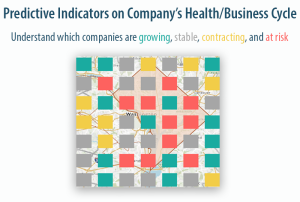
WDBs across the U.S. deploy various outreach strategies – and require predictive insights to pinpoint your targeted list. Some comprehensive address-based databases capture all the 17.5 million businesses in the U.S., but not all come with any means of filtering through the millions of records.
Filtering by size alone is not enough. Did you know that small businesses with 50 or fewer employees represent 98% of all businesses? Conversely, searching by job postings, which are self-selected businesses participating in that forum, represents a small sample of the companies in your community. Neither of these methods is performance-based and offers no meaningful insights.
A multi-layered, flexible filtering system can overlay critical search criteria such as location, sector, size, risk, growth, and diversity. This level of insight enables rapid analysis and decision-making in seconds. More importantly, you can target the right business and contact with the right message for a more successful outcome. Imagine how your batting average and on-base percentage will improve if you know the pitcher’s condition. Consider the runs scored if you understand the company’s financial condition and who to contact before your first call. Imagine if you know who is:

Understanding business dynamics is essential to accelerate business engagement. I’m confident that tracking business conditions within your priority sectors are equally, if not more important than knowing what those priority sectors are. For example, if the manufacturing industry is growing, does it mean all businesses within that sector are? No, it doesn’t! Therefore, knowing which companies are driving the growth and who are not will help you play at a championship level all season long. We know job placements in healthy companies increase the potential for future successful engagements, improve wages, increase retention, and a greater possibility of the employee entering a career pathway.
Using the Moneyball analogy, predictive data enables you to look across the league (state, region, local area, and all sectors) as well as show who is growing and the opportunities for engagement strategies. Just like baseball, you can set a winning game plan for each.
Access to a comprehensive business database and predictive, forward-looking indicators results in rapid analysis and action within seconds. Specifically, predictive analytics enables:
As a WDB, you always want more job seekers to get on base and score. Or, in layman’s terms, get and keep a quality job. Predictive analytics can improve what you’re doing already by helping you be more efficient and effective, yielding more significant outcomes.
How do WDBs measure success? Here are just a few examples:
Bottom line, WDBs are the designated hitters for meeting business needs.
Predicting a company’s financial condition accelerates business engagement. As a result, there are more quality job placements and improved outcomes across the system. That’s playing championship baseball year-round – for the WDB, the job seekers, and the businesses within the community.
PHOTO CREDIT: "Ball Impact. UNF Baseball vs. Florida Gulf Coast University" by DeusXFlorida is marked with CC BY 2.0
Not all data is actionable. There is labor market data. There is business data. And there is predictive business data, which accelerates decision making and action for WDBs.
– by Danny Patterson
We live in a data-driven economy, where there is simply no shortage of data to navigate through – from labor market information, job listings data, workforce data to business data. Each source represents opportunities and challenges for workforce development boards (WDBs).
WDBs are often unsure of what data or a combination of data to leverage to get the insights they need. Or unsure of which data to pull in first for analysis to determine the best path forward. Some only use labor market information with its 50,000-foot birds-eye view of what is happening in their region. But you can’t see the road signs or warnings ahead essential for a smooth trip.
Some take a narrower path, focused solely on the job seekers and job postings from their Wagner-Peyser labor exchange system. While others travel by country road using job listing data as a proxy for a growing business. Each pathway mentioned contains unanticipated congestion, potholes, and the potential loss of their GPS signal. We all have had that experience, and it’s frustrating.
WDBs are best served by using actionable, predictive business data as GPS to point them in the right direction to understand business dynamics.
Instead, in my view, WDBs are best served by using actionable, predictive business data as GPS to point them in the right direction with all the signs and indicators better to understand the dynamics of every business in the community.
Local Workforce Development Boards (LWDB) within a designated region must jointly perform a regional economic analysis and separate but equal analysis for the LWDB strategic plan. While the strategic plan is essential, the underlying data is even more so.
That said, local or state WDBs are overwhelmed by so many spreadsheets and data points that it confuses them into doing nothing or less than they should. Or underwhelmed by the insights that a 50,000-foot level view can derive. Both situations are understandable. But can one truly understand a business from way above? Or know what to do or how to engage in a meaningful way from that viewpoint? The simple answer is no. We all have data. Tons of it, but can we act on it without additional analysis and insight? And this is the challenge for every workforce agency.
All WDBs want is simply data to chart the best path forward. I contend “simply data” is not of any value. But actionable data, presented simply, is of great importance to WDBs.
Workforce Boards will agree unanimously that most of their data is not actionable. Moreover, even though most workforce professionals are not economists, they are responsible for understanding the economy’s conditions. At its purest, the economy is about businesses, locations, jobs, and keeping people employed. Understanding the economy relies on street-level business insights mapped to occupations and jobs data. Imagine if your data could reveal the dynamics inside a priority sector like healthcare or manufacturing. Identify businesses driving the growth and the specific occupations at those businesses, who is stable, and who is contracting? Such data would allow you to develop three distinct engagement strategies for that sector. That’s impact. That’s what actionable data can do for you.
Actionable data has five dimensions. Data must have the ability to be easily filtered for decision-making and action and be separate from the vast amounts of the workforce, economic, and business data available.

Put simply; actionable data empowers WDBs to:
Two primary data sources inform WDBs. They include labor market data from LMI and predictive business data from Dun & Bradstreet/EconoVue. While both are excellent data sources, their effectiveness depends on what you want to accomplish. For example, LMI provides a birds-eye view of a community workforce for strategic planning. In comparison, D&B offers a street-level view of community businesses for targeted outreach. The other providers that serve the WDB market also use LMI data.
WDBs benefit best from using a data visualization dashboard that integrates both to accelerate decision making and action. This matrix below highlights the actionable insights available with a dual approach.

LMI compiles statistical data based on surveys. Labor market data projects the changes in the industry and occupational employment over time resulting from industry growth and technological change. For example, the State of California produces long-term (10 years) employment projections every two years for the State and local areas.
Labor market data provides information to WDBs on the workforce population (skills, demographics, education level, etc.) to understand their workforce compared to business needs (skills, credentials, etc.). This insight allows them to develop training programs to meet the demand. The challenge is to develop programs and ramp them up before the criteria and job criteria change.
LMI is expansive in scope and ideal for strategic planning amongst individual groups. Groups include job seekers, case managers, employers, economic development, education partners, workforce boards, etc. LMI is your go-to resource if you need a high-level overview of employment and wage information over time.
LMI data, however, has its challenges. First and foremost, the data is not truly “actionable” since it is aggregated and developed through surveys. Secondly, the data represents a small fraction of the larger business community. And finally, it only offers a point-in-time sample of large companies. It does not allow real-time or forward-looking views to identify targeted businesses for outreach and engagement. For these reasons, you simply can’t make decisions with LMI data.
Therefore, LMI data is best for broad and overarching strategic planning (e.g., healthcare is a growing sector in all local workforce areas), not targeted outreach where specific and actionable data is required.
When it comes to a genuinely actionable data source, WDBs should leverage up-to-date, predictive business insights from Dun & Bradstreet; all mapped on EconoVue’s intuitive dashboard. WDBs can quickly see a path forward and accelerate decision-making with this tool. WDBs can know what is happening in their local areas with a street-level view of your business community. Understand the health of businesses in your community – who is growing or struggling for more targeted outreach. Reach the right contact at the companies for that outreach. Know what sectors are growing or shrinking or what occupations are expanding. All of these insights result in immediate action for WDBs.
This powerful dashboard offers a variety of views – employment by state and LWIA, employment by sectors, business view of financial stress and material change, and designated regional or local map views with links to specific industries, companies, job listings, and contact information.
All data offers perspective. Only actionable data points you in the right direction with these insights:
This type of actionable information enables you to initiate an informed conversation and targeted engagement strategy with each business. It enables the successful implementation of a proactive engagement strategy. As a result, WDBs can achieve and exceed their performance goals and positively impact people’s lives while serving the businesses in your community.
Workforce development professionals who leverage actionable data in a multi-layered filtering platform can know the best path forward in seconds. Actionable data in an intuitive dashboard is a GPS for WDBs as it provides a clear direction to get to your destination. That destination could be a proactive business engagement or informed prospecting for rapid response or a struggling business.
WDBs can benefit significantly from an interactive dashboard that quickly filters the millions of businesses in the U.S. based on designated region, business health, sector, or other criteria – and pinned on a map to fuel rapid decision making.
WDBs should not get lost on the highway of analysis paralysis. Or meander their way to destinations with paper maps. Spreadsheets are like a traffic jam, stuck for hours with no way out. This GPS approach is a game-changer for WDBs. This dashboard allows precision in determining who to call or visit and why. It speeds to a destination by driving the right strategies and zooms in for more street-level business information.
Actionable, predictive business data is your GPS. It is where the rubber meets the road. This approach is how WDBs can transform their workforce development plans and strategies into action and results. The best plans show us where we want to go and the best way to arrive at our destination.
Simple ways for WDBs to achieve more effective, targeted outreach
Workforce development boards (WDBs) support the economic vitality of the businesses in their communities. Therefore, it is critical for WDBs to keep pace with the changing economic dynamics in their local and regional community, so they can do more effective, targeted business outreach.
Prospecting, business outreach, and messaging, when done right, are key to any WDB’s success. But WDBs are either challenged by too little or too much data, data that is out of date, or worse, not having the right data to know who to reach out to first. Additionally, they are always running against time providing rapid response services, layoff aversions or disaster recovery efforts to businesses. These urgencies require the ability to rapidly and accurately assess the current state of a business prior to contact. Understanding the business health of a community – is a business growing, stable, or contracting – offers the right context for a conversation with a business. Bottom line, workforce development professionals are not data scientists or marketers and struggle to do both. This is where informed prospecting comes to the rescue.
Informed prospecting is a data-driven approach that allows WDBs to thin the haystack and flip the prospecting funnel by pivoting from a wide net of random prospecting calls to a narrow field of top priority target companies. It allows WDB business representatives to not target every single business in one’s community, but rather quickly identify top prospects and reach out to the top 5, 10 or 25 companies first.
There are four simple ways to conduct informed prospecting – from understanding what you are trying to accomplish, who are you going to target first, what are you going to say upon first contact and how to build a long-term engagement strategy.
1 Clearly define and articulate your outreach strategy
2 Pinpoint your target market with predictive, forward-looking business filters
3 Craft a purposeful message for more effective outreach
4 Engage early and often with your top prospects
Informed prospecting results in targeted business outreach with a purposeful message – which is a far more effective and efficient than random acts of outreach.
What is the WDB’s purpose for the outreach?
The first step for any WDB is the clear definition and articulation of your outreach strategy. Forming the right questions upfront will help define the business characteristics and the data required for your outreach analysis. Different use cases require different questions. Ask yourself, what is your WDB’s purpose and goal for outreach? Some examples include:
WDBs that take the time upfront to formulate the right question are able to better predict and target the right businesses open to a specific message – and will yield greater success.
Who should WDBs call first?
The U.S. business universe is over 17 million strong – and depending on the city, county or region, that number varies from 1,000 to 5,000 to 50,000+ businesses. Even with those local numbers, traditional prospecting is a daunting task. This makes it very counterproductive for WDBs to call all the businesses within your jurisdiction for a meager 1% response rate and a few leads. Simply put, no WDB has that kind of time. That is why informed prospecting has emerged as the more effective and purposeful way for targeted business outreach and developing a proactive business engagement strategy.
Informed prospecting relies on a high-quality business database, such as Dun and Bradstreet, and includes filters such as predictive, forward-looking indicators of individual business stress, failure risk and/or significant business change. Using such an approach, WDBs are able to thin the proverbial haystack – and quickly filter by target area, business size, sector, business health, diversity classifications, or other designations.
The funnel diagram below shows the key business filters available for informed prospecting. This dynamic use of filters allows WDBs to quickly refine a universe of 5,000 businesses down to a targeted list of 100 prospect businesses, complete with up-to-date contact details for each of those businesses.
 WDBs work with urgency and have a prevailing need for a rapid assessment of a community’s business, workforce and sector data for targeted business outreach.
What should WDBs say when you reach a prospect
A good messaging strategy stems from your overall outreach strategy, but is further shaped by what you know about the current state of the business you are calling. Different strategies call for different messages, depending on what stage the business is in.
As you start to engage with a business, listen carefully and pivot the conversation as necessary. Sometimes a business has done a lot of hiring and appears to be growing, but they’re not growing, they’re just churning employees. Probe as to why, listen, and offer a solution. In another example, a business had a medium financial stress score and appeared to be contracting, but when speaking with them, it was discovered the stress was actually due to growth and what they really needed was more space and capital.
With that in mind, here are some messaging strategies for a growth business, a stable or stagnant business and a struggling business. Remember, always listen, probe, recommend a solution and pivot as necessary.
Listening to what is going on with a business and offering solutions at zero cost to them, is a great way to demonstrate the value WDBs can deliver to their constituents.
How do WDBs build a lasting relationship
Every strong relationship starts with listening – and understanding their business needs. While you may have a high-level understanding of the current state of a business at first contact – whether it is expanding, stable, or contracting – you may not understand why.
Every touchpoint is an opportunity to learn more about the business, deliver value and build a stronger relationship. Such interactions include but not limited to:
Be Successful by Not Targeting Every Business in your Community
Workforce Development Boards can benefit greatly by adopting an informed prospecting approach – that is, pivoting from random acts of calling to that of targeted, purposeful business outreach. WDBs that apply informed filters to a business database to thin the haystack get a fast start to informed prospecting. Whether you are targeting businesses in emerging industries, micro and small businesses, or under-represented groups such as minority-, women-, and veteran-owned businesses, always start with your short list of top prospects first and reach out with purpose.
State Vue – Impact of the Great Job Shift
The labor market is experiencing historic change. The change ranges from a seismic workplace shift, high quit rates and resignations to the lowest unemployment numbers in decades.
But it is this recent shift to remote work that has put contact businesses – those that require customers or their workforce to be in a central location – at risk of failure. Business failure risk is defined as the High/Medium/Low probability of “financial stress” (i.e., failure or closure with outstanding debt) over the next 12 months.
A nationwide Vue of Dun & Bradstreet® data indicates there are 223,000 businesses at risk spread across the United States, with the lowest risk in the Midwest.
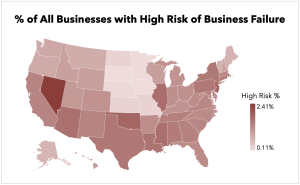 Interestingly, a State Vue of high-risk contact businesses shows a very different story. Of the 87,000 contact businesses nationwide at risk, the highest concentration is in the Midwest. The top 5 states at high risk are North Dakota, Iowa, Nebraska, Kansas, and Minnesota. Key sectors impacted largely span mining (especially in ND), manufacturing, and retail, depending upon the state.
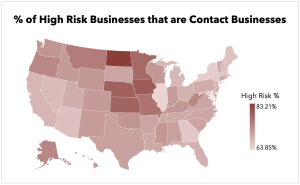 The shift in the workplace and the resulting risk are significant. So, workforce development boards across the nation should prioritize contacting businesses for targeted outreach.
Four best practices for workforce boards nationwide
– by Danny Patterson
State and Local Workforce Development Boards (WDBs) have the opportunity to become the unsung heroes within their state – and make an even greater impact on their communities. Some innovative workforce boards are already leading the way, while others resist the opportunity. The question is why?
In 2014, the Workforce Innovation and Opportunity Act (WIOA), provided the guidance and framework for a proactive business engagement approach to WDBs nationwide. Some WDBs fully embraced this guidance provided in the written law and its accompanying regulations, yet other WDBs still focus exclusively on rapid response activities as the complete directive. If focus is limited to Rapid Response, the odds for success are instantly stacked against the local WDBs, as the system is wired to be reactive – the need to develop and maintain local systems to be informed or aware of a layoff event, to react when one has occurred, and then try to minimize its impact by marketing services and support available to dislocated workers through the OneStop system.
Some say the proactive business engagement approach is too heavy of a lift. I agree, but only if you lack the right data and research tools. Based on my own positive experience implementing this approach statewide in California, here are recommended best practices to guide the shift to a proactive business engagement strategy for greater impact:
1 Proactive business engagement requires a partnership mindset
2 Data-driven approach fuels the right engagement strategies
3 Measurable impact is not only quantifiable, it is simple math
4 Actionable data redefines what’s possible for workforce boards
The bottom line is this: workforce development boards and their OneStop Centers are an employment-based program as evidenced by the common measures. So, the goal remains the same regardless of the approach – develop a skilled workforce and keep people in the labor market. The difference then is the amount of positive impact to the community.
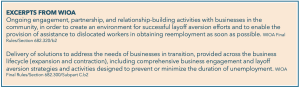 Too often, WDBs primarily focus on rapid response despite the written law providing guidance on and encouraging proactive business engagement. They read about a closing in a newspaper and then reach out. I had a slogan when I was the Rapid Response and Business Engagement Coordinator for the California Workforce Development board, “Rapid Response is a failed business engagement.” In my view, it is a broken business model – while it is understandably mandatory, it’s reactive versus proactive – and often too late to make a difference. I recognize the difficult and challenging work carried out by the local rapid response representatives, it is a herculean lift and applaud their efforts, but it remains a reactive response, driven by a business closure or workforce reduction of which they have no control. WDBs can no longer focus on just rapid response. There is another way!
A proactive business engagement strategy is increasingly becoming the new normal – a strategy that spans across the entire lifecycle of a business: from business development to contraction to expansion. Workforce boards have a dual responsibility – 1) to partner with healthy businesses to enable growth and hiring and 2) to partner with struggling businesses to avert layoffs or downsizing.
WDBs work with businesses in a growth mode for two reasons; a) to help them meet their needs for a skilled workforce and provide increased and diverse opportunities for job seekers, and b) to develop business relationships so that if a company is going through a layoff, the WDB can help the impacted workers rapidly find employment with companies that have available opportunities and need their skill sets.
WDBs also need to identify businesses who are struggling and in danger of closing – to help the business if the owners desire to preserve their company and its employees, through the use of proactive strategies such as professional marketing assistance to increase access to new clients and markets, incumbent worker training to upskill the existing workforce, use of lean principles, connecting them with small business development centers or economic development agencies to access needed financial resources, or to work with them in advance to help the soon-to-be-impacted workers. Similarly, we want to be able to facilitate rapid reemployment and connect workers with businesses through short-term, on-the-job, or customized training programs and apprenticeships.
This is proactive business engagement – where a WDB is a valued partner, actively engaged and vested in the business’s success along the entire business continuum.

Today’s reality is that most local WDB practitioners are chasing data rather than having predictive business level information pushed to them. They lack the reliable business data to anticipate business change or predict failure of businesses. Instead, they rely on who/what they already know or have easy access to, such as newspaper articles, business associations, etc. Moreover, the majority of the layoffs don’t meet the federal WARN requirements notification criteria (i.e., employing over 100 full-time workers), so small-to-midsize businesses who are at risk and are laying-off workers are invisible to local WDBs. There is also a reluctance of businesses to share access to their dislocated workers with the local WDB, largely because workforce boards are not recognized as assistance partners. Additionally, most businesses are not aware of the workforce development system or their menu of business services. This creates a heavy and unnecessary lift for any workforce board.
We found that a data-driven approach provides the best-in-class business, workforce, industry, and business health data – which is organized on an interactive, multi-dimensional dashboard. This enables industry sector and trend analysis at the local or regional level, business and workforce research, time-series data comparisons to improve business outreach and engagement programs. The ability to then filter these data by changes in company health, NAICS, business size and geography, provides a refined list of the exact businesses which may be open to the outreach messaging of a WDB. By leveraging this actionable data, workforce boards can be proactive versus reactive, understand the changing dynamics of businesses to drive the right engagement strategies and minimize impact quickly. Key insights include but not limited to:
The constant stream of business information and insight about businesses, industry health and trends is essential to predict the ebbs and flows of expansion and contraction before it occurs. A continually refreshed list of companies and contact details makes the data actionable.

Measuring impact is always challenging. While federal workforce programs focus on three metrics – job placement, job retention and wages, they do not specifically measure the “jobs saved” if a layoff is avoided altogether (how can one measure something that never happens?) In spite of this, some local boards have taken the initiative to seek more granularity to justify specific program costs, such as jobs saved, even though it is not a reportable item per WIOA.
What gets counted matters. When workforce development boards have strong partnerships with the businesses in their jurisdiction and are actively engaged in their success, the businesses are more likely to share results. Let’s use my own past experience in California as an example of how workforce boards can measure impact using standard metrics in a simple equation.
The State of California has a directive to report both rapid response activity and layoff aversion (jobs saved) activity. For example, after the first year of adopting a data-centric approach to layoff aversion, the California Workforce Board found a way to easily report and quantify the impact. First, they needed to understand the health of the businesses – healthy and growing, contracting but still operating, or closed – across the jurisdictions covered by the 45 local WDBs. Each WDB was provided with the data and research tools to find struggling companies and proactively implement individual strategies for these companies to avoid layoffs. This is proactive business engagement – and the impact and ROI was significant.
Below, I share our simple model that can be used for any state. For purposes of illustration, I have populated it with a very reachable scenario of number of total jobs saved across the state after a year of proactive engagement with struggling and growing companies. Unemployment weekly benefits range from $235 to $823 per week.
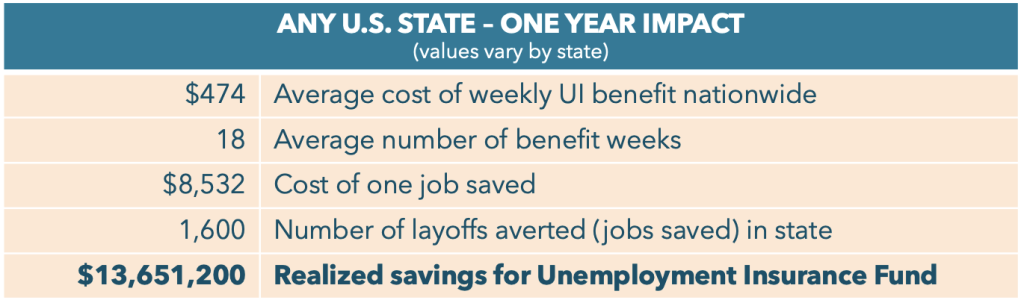 In the year one example above, the State realized measurable results from their data-driven, proactive layoff aversion strategies. 1,600 people remained employed. 1,600 people remained taxpayers. Eliminated the emotional trauma of job loss to families. Business owners did not experience an increase in their UI contribution rate. $13.6M in savings for the State Unemployment Insurance fund. This savings and impact is realized year over year.
Workforce boards today are limited by their lack of actionable data, not their vision. Barriers exist today through no fault of the local boards. The world of actionable data can unleash a world of opportunity for WDBs. Imagine the greater impact that can be achieved if workforce boards:
By embracing the “art of possible” with actionable data, WDBs can have a far greater impact on the job seekers, workers, businesses, and the community.
People are the driving force of the labor market. The goal of workforce development boards is to keep people in the labor market. When jobs can’t be saved, WDBs need to focus on impacted employees. and ensure rapid reemployment for people within the community in healthy businesses that pay good wages, offer health and medical benefits and provide on ramps to careers, not just jobs. When these layoffs are unavoidable and do occur, lives are disrupted, both for the employees and their families – and depending on the size of the layoff, the community.
That is why a proactive business engagement strategy is the path forward. Building a strong network of healthy businesses who are paying good wages, pays off in the end. That is why having the up-to-date knowledge on who is healthy and growing and who is struggling so you do some advance work on the front end rather than reacting to a layoff event is so critical to supporting the economic vitality of the community.
People matter. Businesses matter. Communities matter. That’s why workforce development boards exist. And why the greater impact WDBs can make with a proactive business engagement strategy is so important.
My Point of Vue: A Personal Look at Workforce Development with Ulisse Gallo
Academically, I’ve always known that the bulk of the American workforce and economy can be found in small and mid-sized businesses. On a recent drive through the Northeast, from Maryland to Canada, this idea really came into focus for me and got me thinking deeply about understanding the needs of all businesses in a workforce area.
As I passed town after town, I didn’t see skyscrapers and large office buildings. I saw Main Streets filled with mom-and-pop businesses – diners, machine shops, local markets, and family practices. I got a front row view of a slice of the American workforce that rarely gets mentioned in headlines, but is the powerhouse of the local economy and the backbone of their communities.
Each week, I talk to teams at Workforce Development Boards (WDBs) around the country – metro, rural, big, and small – and one of the constant, recurring challenges they share is finding ways to really understand the subset of businesses with 10-50 employees. Sometimes they call this group the invisible economy or the overlooked workforce, and the lack of visibility into their financial health, growth patterns, and resource needs makes it difficult for WDBs to identify and engage with this critical market.
Detailed business level data is one of the keys to successful Board outreach programs – this is true for all businesses, but especially those with 10-50 employees.
Generally speaking, 85% of the businesses in a local Workforce region fall into this key category. WDB Business Service Reps should ask themselves: How well do you know the businesses with 10-50 employees in your region? How clear is your visibility into their needs, wants and opportunities for growth? How broad is your reach and how effective are your communications?
Taking a strategic approach to reaching the small and mid-sized businesses in the local workforce area allows Boards to effectively and efficiently engage with the companies that are most likely to be open to their message.
After all, we want the entrepreneurs, business owners and people working on Main Street to thrive. And we never want to lose sight of the hidden economies that make up our communities.
My recent road trip took me through the Northeast region of the U.S. – home to 3.8 million businesses. But only 10% of these have 10 or more employees. Of that subgroup, 86% (or 270,000 businesses) have 10-50 employees.
When faced with large numbers of businesses for potential outreach, WDBs can employ a ‘funnel strategy’. This allows WDBs to narrow a list of thousands down to the dozens. Ultimately, those who are most likely to respond to the targeted message are those who 1) narrowly define the project scope, 2) fine-tune the contact list, and 3) develop messaging that speaks to the business’s current needs.
Two key elements in targeting businesses are assessing Failure Risk and identifying whether the business is in Growth or Contraction. Let’s look at businesses in the Northeast with 10–50 employees. Only a very small slice is High Risk for failure in the next twelve months, and more than half are Low Risk.

Let’s look at more short-term business activity indicators. We see that 8% of businesses are showing signs of business contraction or compression. Meanwhile, nearly one-third of all businesses are demonstrating activity triggers indicative of growth and expansion.

Mixing and matching these business health indicators, a WDB can funnel the data results into very specific outreach categories:
To further refine results into a highly targeted outreach list, workforce developers can layer in additional filters and indicators. These filters and indicators should closely align with the outreach goals. For example, some factors to consider are industry sectors and sub-sectors. Additionally, geographic boundaries, demographic indicators, corporate structures, loan data and more are important.
In my conversations with Workforce Development Boards who have implemented this ‘funnel’ approach to outreach, they report increased effectiveness. They also mention higher engagement rates throughout their region and across multiple industries. How will it work for you?
Read our earlier post – My Point of Vue: A Personal Look at Workforce Development with Danny Patterson – for a look at the 1980s version of network building and what it means for today.
A typical Workforce Board interacts with 5% of local businesses. Three questions to help build a better employer network in a strategic way and identify new, potential partners that strengthen your Board’s connection to the community.
At Workforce Development Boards and OneStop Career Centers, the number of job seekers and businesses that need your help has grown, but has the pool of businesses you regularly work with also grown to meet the demand? Consider asking yourself 3 questions to help build a better employer network.
The good news is that we’ve moved beyond using Rolodexes and the yellow pages to find our next strategic partner. Today’s robust data and research tools give us a more complete picture of our local business communities and can help us identify and connect with a higher number of healthy, growing companies.
Ask yourself these questions to start building a broad business network:
Get a deeper understanding of the businesses you regularly work with. Knowing the strengths (and weaknesses) of your core employer network is the key to maintaining strong partnerships, collaborative advisory groups, and effective community connections.
Consider these characteristics:
A typical Workforce Board interacts with 5% of local businesses. To expand your network in a strategic way, take a birds-eye view of the remaining 95% and then narrow your focus to identify new, potential partners that strengthen your Board’s connection to the community.
Some categories to investigate:
Your outreach will only be as good as your data. Invest in data resources that give you a complete picture of your local business community. Look for employer, industry and workforce data that is:
Building a business network that grows along with the needs of your community is hard – but necessary – work that supports both employers and workers. Take the time today to strategically invest in a stronger network tomorrow.
In the early 1980s, I completed Technical Training school and began my military career as a purchasing agent. The tools of my new trade were the yellow pages, a desk phone and an 80 column coding sheet. My workload was a never-ending stack of purchase requests that filled my inbox.
I quickly learned there was a well-established history with a small number of preferred vendors. If leveraged correctly, they could help me meet my performance goals. They could also help empty my inbox – even if temporarily – and I could generate some regular business for them. This situation was a win-win!
As my responsibilities increased, I needed my network to grow along with me. This was when the hard work not covered in tech school began.
It wasn’t easy making cold calls to the potential vendors I found in the yellow pages. However, as I worked to hone my message and learned new business practices, I was able to establish new relationships. These were built on trust, credibility, and mutual benefit.
I wish I could say the stack of purchase requests stopped growing. But the larger network certainly helped me keep it in check.
Fast forwarding to present day, Career Centers face a very similar challenge, but from a different vue. For those who serve in OneStop Career Centers across the nation, the time is now to cultivate new relationships. Therefore, it is time to build a bigger network. The number of job seekers and businesses that need your help has grown, but has the pool of businesses you regularly work with also grown to meet the demand?
Thankfully, we’ve moved beyond the yellow pages. Today’s robust data and research tools can help you identify and connect with a higher number of healthy, growing companies. As a result, you get a complete picture of your local business community, especially those companies that are currently off your radar.
If built well and for the long haul, a broad business network will provide expanded, quality career opportunities for job seekers. At the same time, you will be able to help more businesses meet their needs for a skilled workforce. You will also contribute to the success of your organization’s performance goals. This is a win-win-win if I’ve ever seen one.
So ask yourself, “Who is in my current network?” More importantly, ask “Who should be? And how will I find them?”
Read our earlier post – My Point of Vue: A Personal Look at Workforce Development with Danny Patterson – for an introduction to the art of angling for more successful business engagement.
Successful anglers know the key to catching more fish is the proper balance of three factors: location, fly selection and presentation.
It seems simple. But taking care to properly execute each step is the difference between an angler who consistently catches more fish vs. one who may have only an occasional good day on the water.
And, it turns out, understanding these fly-fishing fundamentals can also teach us a lot about successful and proactive business engagement strategies.
Location
An angler’s first goal is to cast their line in places where the fish they are targeting are plentiful. Finding the perfect spot on the river is not guesswork – their ability to ‘read the water’ is vital and enables an angler to pick their location and throw their fly with confidence.
In the same way, successful business engagement strategies benefit from understanding the environment companies are operating in. This knowledge helps you reach out with greater accuracy and confidence, and you won’t waste time casting into empty ponds.
Some deep-dive questions to help build your understanding of a company’s location include:
Fly Selection

A good angler also needs to know a lot about bugs. For example, a single trout will eat from 13 major categories of insects. To properly prepare for a day casting for trout, an angler will fill their tacklebox with flies resembling the varieties that best match the location and the season, avoiding trial and error. With a carefully selected assortment of flies, they can quickly and easily respond to conditions on the water to start pulling in trout.
This practice is also true for business engagement. Matching your message to a company’s ‘location’ and season gives you the greatest chance of building a connection. Your Board may have a dozen valuable programs and resources – but the company in front of you will only be interested in one that meets their current need. By carefully tailoring your message, you increase your chances of breaking through the communication overload and getting a response.
What’s in your messaging tackle box?
Presentation
It’s all about the drift. An angler’s hard work and preparation come together when the right fly is presented and moves naturally within the pace and flow of the river: presenting an opportunity that fish can’t resist. The more the angler gets right during preparation and planning, the more successful their drift will be.
As business engagement specialists, this is where the preparation pays off. With actionable information regarding the environment you are operating in and details about the businesses you are trying to engage, you can craft a targeted message using an appropriate platform that will flow naturally and lead to a positive dialog.
Successful anglers use a strategic approach that works to catch more fish: changing their location, fly selection and presentation tactics to best align with the particular fish they are targeting.
Workforce teams can take a similar approach – building outreach and engagement strategies that consider where a company sits in the flow of the economy (location), what solutions can be offered to respond to their current need (fly selection) and how to communicate in a way that best connects with the business owner (presentation).
A few weeks ago, I found myself seated next to a stranger at a local fundraising dinner. We chatted through the usual topics, eventually sharing what we do for a living.
“I’m retired,” he said. “I’m also an angler.”
A very particular and precise way to describe oneself, I thought, and I asked him to tell me more.
I discovered that he is a successful fly fisher and ties his own flies, a hobby he has turned into a small business. As he was joyfully showing me pictures of his detailed and intricate work, he began to describe why some become anglers and others remain fishers. Now he had my attention!
“Do you know that fish in rivers have a keen sense of their environment, and they recognize the types of insects naturally present in the water shed?” the angler asked. “Did you know they also recognize the way insects move across the surface of the water, and the cycle of life they are in?” He went on to say that fish also recognize things that are foreign to their environment.
Understanding these variables is what separates the fishers from the anglers.
A fisher who drags their fly across the tide and natural flow of the river will always be frustrated. But an angler who studies the streamways, knows the habits of local insects, and works to drift their line in a recognizable pattern will put more fish to net every day of the week.
The next day, I considered his comments in a different light.
It turns out fly fishing has a lot in common with the development and implementation of a successful and proactive business engagement strategy. If you lack actionable information regarding the environment you are operating in and details about the businesses you are trying to engage, you risk being perceived as something uncharacteristically scurrying across the natural workflow and your engagement efforts will fail.
Instead, think like an angler. Do some homework, gather pertinent information and actionable data, study the flow of things and know the environment – and then cast your line. You are certain to be more successful.
What about you? As a business engagement professional, are you an angler? Or do you “just fish”?
EconoVue™ is your window to business and workforce insight.
Founded in Silicon Valley in 1999, and now based in Arlington, VA, EconoVue, Inc. is a woman-owned small business with a single mission: to help our clients visualize data and gain actionable insight into the past, present and future of their local and regional economies and workforce.
Originally founded as The Urban Explorer, Inc, a boutique consulting firm designing interactive GIS tools for economic development, land use planning and urban design, we heard a common theme from our customers: “Help us analyze today and help us predict tomorrow.” We found ourselves replicating the same steps of geospatial economic analysis studies, so rather than reinvent the wheel every time, we decided to invent it just once and automate the process via a single platform, and EconoVue™ was born.
The millions of businesses that comprise the U.S. economy and workforce are constantly in motion. Our agile approach to solution design is highly collaborative with the “end-user”, constantly evolving to meet the growing needs and creativity of our clients as they try to extract insight from data chaos.
Working with our data partners, public sources and our great collaborative clients, we continue to expand EconoVue™ to meet new needs, including Economic Development, Transportation and Custom Analysis. Our design philosophy is to produce innovative, actionable data insight tools, in a modular application platform that is iterative and easily adaptive to meet the ever-changing information needs of our clients.
