 EconoVue™EconoVue™
July, 2020
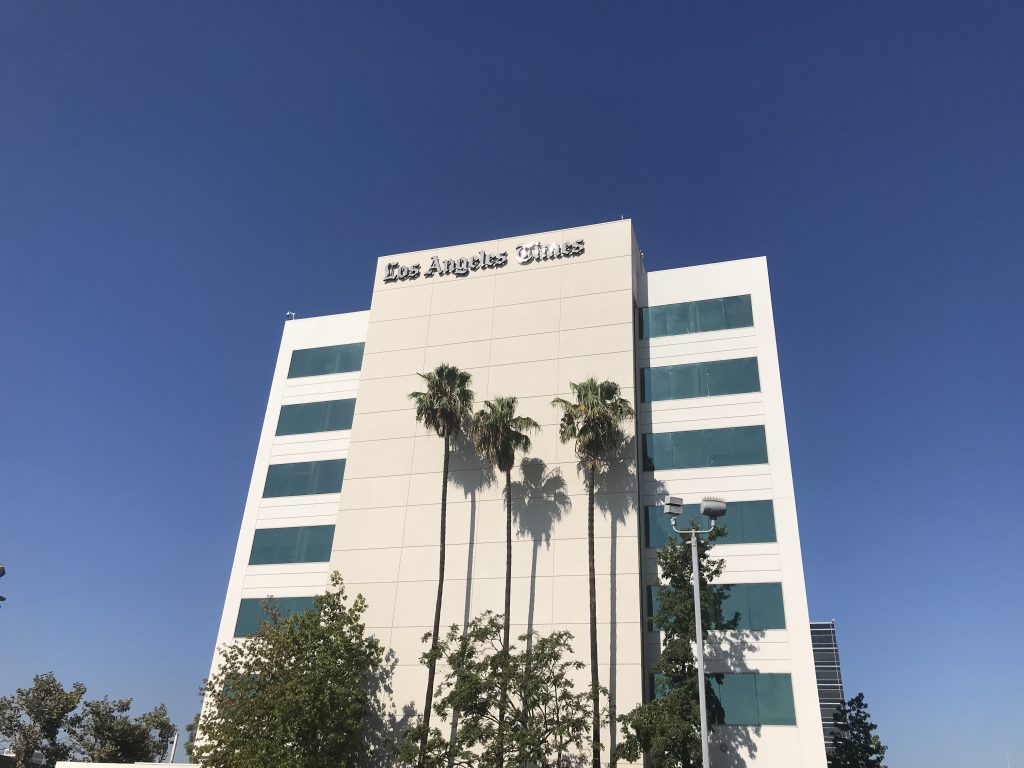
Recently, the writer’s union for the Los Angeles Times made their own headlines when they announced an agreement between the Guild and the paper to avoid layoffs. This solution involved a temporarily reduced weekly schedule.
Typically in times of economic downturns the only remedy available to employers is drastic cost cutting – and as advertising revenues at the Times plummeted, layoffs seemed inevitable. But representatives for the L.A. Times Guild team found a better way:
“We discovered a potent, but little-known, layoff prevention program known as “work-sharing.” Employers who participate in work-sharing can avoid layoffs during a temporary downturn by shortening employees’ hours. Workers maintain health and retirement benefits. Workers can collect prorated unemployment benefits to offset lost wages. Hours are restored when the downturn ends..“
The management team at the Times quickly agreed, preserving 80+ jobs and cutting payroll costs by over $2 million. Guild president, Anthony Pesce, called the outcome “…the best possible deal we could have made under the circumstances.”
State work-share programs let businesses temporarily reduce the hours of their employees, instead of laying them off during financial crises. Often referred to as short-time compensation, the goal of work-sharing programs is to reduce unemployment.
Workforce Development Boards on the front lines of layoff aversion efforts in their communities are in a great position to connect at-risk businesses with work-share resources – and EconoVue™ helps Workforce Boards identify financially at-risk companies before any layoffs have occurred, and to explore creative layoff alternatives like work-share.
Using the EconoVue Employer Risk Indicators to create a targeted outreach focused on small businesses, a Silicon Valley Workforce Board recently connected with an electronic component manufacturer who had lost a big contract. By helping the company apply for work-share assistance, the at-risk employees were able to maintain their employment and benefit status. They did this by working a reduced schedule. As a result, the employer avoided additional financial hardship. The employer also avoided future hiring costs.
The Board’s Business Services Manager shared her story with us. “Using EconoVue made it easy to identify at-risk companies in our priority sectors. We paired this struggling company with CA Work Share. And reduced the company’s financial stress and helped them retain their employees.”
Want to learn more about how EconoVue can help your Workforce Board? Want to identify and connect with companies in your region that are good candidates for work-share? Comment below. Or reach out for more details and a personalized demo.
For more information, visit www.econovue.com.

PROGRAM GOAL: Establish Employer Partnerships with the Local Community College...

Here is the August 2026 EconoVue Newsletter. EconoVue is pleased to announce our...

PROGRAM GOAL: Pre-WARN Rapid Response Outreach for Anticipated Worker Displacem...

PROGRAM GOAL: Recruit Employers for Youth-Jobs Portal. WDB NEED: Incre...
EconoVue™ is your window to business and workforce insight.
Founded in Silicon Valley in 1999, and now based in Arlington, VA, EconoVue, Inc. is a woman-owned small business with a single mission: to help our clients visualize data and gain actionable insight into the past, present and future of their local and regional economies and workforce.
Originally founded as The Urban Explorer, Inc, a boutique consulting firm designing interactive GIS tools for economic development, land use planning and urban design, we heard a common theme from our customers: “Help us analyze today and help us predict tomorrow.” We found ourselves replicating the same steps of geospatial economic analysis studies, so rather than reinvent the wheel every time, we decided to invent it just once and automate the process via a single platform, and EconoVue™ was born.
The millions of businesses that comprise the U.S. economy and workforce are constantly in motion. Our agile approach to solution design is highly collaborative with the “end-user”, constantly evolving to meet the growing needs and creativity of our clients as they try to extract insight from data chaos.
Working with our data partners, public sources and our great collaborative clients, we continue to expand EconoVue™ to meet new needs, including Economic Development, Transportation and Custom Analysis. Our design philosophy is to produce innovative, actionable data insight tools, in a modular application platform that is iterative and easily adaptive to meet the ever-changing information needs of our clients.
