 EconoVue™EconoVue™
April, 2023
Key success measures for business engagement
by Danny Patterson
State and local workforce development boards (WDBs) lead a broad list of essential workforce programs from rapid response and layoff aversion to apprenticeships and incumbent worker training, DEI, and justice-involved, and youth programs within their communities. And that is just the tip of the iceberg. These programs involve many constituents from the community, including the business partner.
Like all publicly funded programs, a certain level of accountability is involved. The workforce system has become very efficient at calculating the outcomes of WIOA common measures, such as placement, wages, and retention.
However, measuring the impact beyond those mandated measures remains a constant challenge for WDBs. WDBs also track and report skills gains and credential attainment, which ultimately inform the above three measures.
But what about the business effectiveness measures we were to pilot? To date, we haven’t had the same level of success! In fact, the WIOA reauthorization bill that passed the House last year admitted as much and removed them stating several reasons. So, only some WDBs measure and report business engagement as a standard practice. The question is, why?
The employment and training system has always had a dual customer model – the job seeker and business. It’s supply and demand. It seems contradictory to that well-known adage that what is measured is important, yet we continue to focus measurement almost exclusively on the supply side, the job seeker.
But we know we can only make quality employment referrals for our clients with effective business relationships. Therein lies the dual customer challenge. So, what are we left with? We may collect some data points and report some numbers to the state, but they go nowhere! The feds certainly don’t publish them.
What’s needed is a way forward. The common denominator of the current measures is business. The lynchpin of any vibrant and successful workforce development program are businesses.
The businesses in a community represent the demand side of the workforce system. They also provide valuable insight into the labor market and what’s coming on the horizon. They are the first to recognize a need for new skills and can help build effective training and educational programs to respond to that need.
This administration’s focus on expanded apprenticeships is one example of a training program developed by and for businesses. It is why businesses have the majority membership on all state and local workforce boards.
If we are going to measure something, we need to define it first.

Always start with what we know – the total number of businesses registered in the system and those that have accepted referrals or are posting job vacancies. Equally important, much like the placement rate, we need to know the percentage this number represents of the total business universe.
After all, how can we tell if we are impacting the priority sectors in our local plan if we only count those businesses that opt in? It’s a simple denominator and numerator calculation.
We can only do this effectively if we have a reliable source that can tell us how many businesses there are in my state or local area and in a sector. DOL refers to this as the penetration rate. Today, we are only using the numerator!
As the tip of the spear of the workforce system into the business community, business engagement does matter. The challenge in measuring the impact of business services is that it is too hard to quantify. If you read your federal year-end report, it doesn’t show up there, so how do we show our value?
First, we know a good business services team identifies quality opportunities for our job seekers. You can easily correlate the job placement rate and the quality of those jobs to your engagement efforts. But there is another side to that equation. What’s the impact on the business? Do you know?
Business Engagement Metrics
As shown in the diagram below, tracking outcomes from the work you do every day can capture the breadth and depth of business engagement long before the “placement and wages” occur.
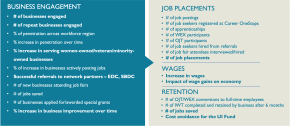
Now let’s look closer at what’s possible in measuring the progress and success of business engagement and your effectiveness in serving employers.
Measuring business engagement within your workforce system starts by first understanding the percentage of the business community you are presently engaged with and then growing that percentage year over year. Engaged means active participation, such as posting job vacancies with you, being willing to receive referrals from you, being involved on a business advisory council, or conducting sector strategies. You get the picture. Engaged does not include a company on our mailing list that gets stuff from you. As we grow that number, we increase business awareness of our value as partners and their choice to participate in the system.
They do so for one simple reason: the value it brings to their business. There are other values at play here, too – an increased opportunity for our job seekers, and if we do this well, positive word-of-mouth advertising. If a business is happy partnering with you, the business will tell others. Like you do with recommendations about restaurants, movies, wine, or cigars. A good referral between businesses is worth tons to our system. That should be our goal – valued partnerships that promote our network. What percentage of the businesses are you engaged with across your community? You can see the opportunity already!
Just like we don’t recommend bad restaurants or movies to our friends, a business seeking repeat business is an indicator of the quality of service provided by your team. Job placements are top of mind for every workforce board across the nation. It’s measured; it matters. Job creation is reported every month at the national level, and over the past months, we have seen strong job growth. Moreover, the need for a skilled workforce is ever-present. As reported in The Hill, the ratio of job openings to unemployed workers jumped to a near-record of 1.9, meaning that there are nearly two job openings in the U.S. for every job seeker.
This current workforce dynamic creates a diverse set of opportunities across your entire region – for highly skilled workers to those requiring public assistance to those just entering the workforce. And most importantly, for workforce boards, this creates an opportunity to serve both the job seeker and the local business. But where are these opportunities in your community?
98% of all businesses in the United States have less than 50 employees and represent the rich diversity of our local and state economies. Not all WDBs are using national job boards to fill vacancies. But they should be using you. If we grow the pie, we grow the opportunity and can serve both the business and the job seeker. Quality jobs, a skilled local talent pool, and opportunity – now that is a win, win, win. Job seeker, business, and you, the workforce system – the intermediary between these two customers of our system.
Many federal and state grants specifically target businesses representing certain ownership groups. And WDBs need to continually measure the increased diversity, equity, and inclusion across all programs. To do that, diversity classification data is essential to report participation across the community’s full array of businesses.
It is also important to measure the quality of your partner network. Do you refer businesses to your local EDC or SBDC for things outside your toolbox? If not, you should be! What if a business needs to upgrade equipment, have more space to expand, or grow its market share? We need our network to help and deliver when called upon. It shows the strength and commitment of your effort on their behalf because you have built this toolbox and this network of partners to provide valued services to the business community, whatever they need, that’s thinking and measuring beyond placement!
These are just a few things to consider as you consider ways to improve how you measure and report your impact and benefit to the business and the job seeker because you serve both.
Why does it matter? A quick review of the FY21-22 Annual Performance Reports shows roughly 68% of all participants retain employment after the 2nd quarter following program exit. Would a larger pool of employers, full of healthy and engaged businesses, raise that number? I say yes. It’s obvious. Do you know if you are engaging with 4% of employers in your system or 4% across your workforce area or region? The difference matters because the level of engagement is an important distinction and opportunity. But as I said above, we only know what we measure. We can and should do better.
If the foundational premise of our system is one of continuous improvement, once you know the numbers, you can better set future goals to increase the level of business engagement year over year. Grow your piece of the pie, or continuously improve.
Yes, it’s hard to move the needle. But if we look at each local area as a slice of that pie, the needle moving can happen easier.
This measure could also be a basis for states to provide incentive awards to local boards, striving to achieve positive change in this area of business engagement.
After all, what is exemplary performance? Define that in a way that pushes growth and engagement.
We measure client success, and we’ve talked about increasing the size of our business community pie. What about measuring our impact on the business itself? WIOA Final Rules tell us that we should engage with businesses at all points in their business cycle. So, business engagement is more than just placement or waiting for layoffs or mass hiring events. Instead, it is an all-in strategy!
But how can we measure impact at that level? Let’s use an example of a sector near and dear to all of us – healthcare! Do you know many healthcare facilities are in your state/local area? You should. Do you know who in that sector is driving that growth? You should because we know, in business, not all ships are rising with the tide. We need data at this level of detail to develop strategies within sectors. We have different toolbox strategies for those growing, for those stable over time, and for contracting businesses. This strategy is what WIOA and its authors intended as proactive business engagement.
Measuring impact starts with establishing a baseline before that first visit. It continues by engaging with them over time, offering quality solutions as needed. Just as a successful placement has several touch points with the system as they progress in their careers, it should be the same with our other customer – the business. As they also move through their business cycle, we want multiple touchpoints and a toolbox for each. With this approach, WDBs create a valued partnership.
If you measure these or other ways, this becomes quality information for your board, your team, and your community. This information also demonstrates how you can be a valued partner to the business.
Some innovative WDBs have taken the initiative to measure success with more granularity, even though not required. Other WDBs track economic impact through increased revenues and specific community impact measures.
Some boards calculate impact with data readily available – earnings spent in the economy. It answers the so what test. A scenario: you placed 2500 participants in jobs in FY21-22, earning a median wage of $7,500 a quarter. 4th quarter 70 percent of participants are still employed. Those efforts bring $52,500,000 into your local economy that year. That is an impact beyond the common measures.
The most progressive boards also use cost-benefit analysis and return on investment calculations. These data points inform the common measures. They demonstrate to our communities, state, and local elected officials, and board members that targeted business engagement does, in fact, feed outcomes. It does matter and should be measured. It’s about growth, and it’s about revenue and quality of jobs, and quality of life for our residents.
The top goal of every workforce board is to develop educational pathways that lead to quality jobs with secure full-time employment for skilled workers. For that to happen, you need to partner with financially strong employers with good-quality jobs. You need to support businesses through the ups and downs of their business cycle. To measure your total impact in your community, you must go beyond the common measures and acknowledge that this system has two customers. It is essential to track every business engagement and know your denominator. You need to understand your impact today and over a period of time. And understand the impact at both the business and sector levels. Use that success to tell the rest of the story.
PHOTO CREDIT Adobe Stock Photography

The Commonwealth of Massachusetts Expanded Employer Sponsor Participation Throug...

Here is the September 2026 EconoVue Newsletter. This month, we salute all workfo...

Turning Business Signals into Smarter Economic & Workforce Development Colla...

PROGRAM GOAL: Identify Foreign-Owned Business for Tariff Impact Assessment....
EconoVue™ is your window to business and workforce insight.
Founded in Silicon Valley in 1999, and now based in Arlington, VA, EconoVue, Inc. is a woman-owned small business with a single mission: to help our clients visualize data and gain actionable insight into the past, present and future of their local and regional economies and workforce.
Originally founded as The Urban Explorer, Inc, a boutique consulting firm designing interactive GIS tools for economic development, land use planning and urban design, we heard a common theme from our customers: “Help us analyze today and help us predict tomorrow.” We found ourselves replicating the same steps of geospatial economic analysis studies, so rather than reinvent the wheel every time, we decided to invent it just once and automate the process via a single platform, and EconoVue™ was born.
The millions of businesses that comprise the U.S. economy and workforce are constantly in motion. Our agile approach to solution design is highly collaborative with the “end-user”, constantly evolving to meet the growing needs and creativity of our clients as they try to extract insight from data chaos.
Working with our data partners, public sources and our great collaborative clients, we continue to expand EconoVue™ to meet new needs, including Economic Development, Transportation and Custom Analysis. Our design philosophy is to produce innovative, actionable data insight tools, in a modular application platform that is iterative and easily adaptive to meet the ever-changing information needs of our clients.
