 EconoVue™EconoVue™
September, 2026
Turning Business Signals into Smarter Economic & Workforce Development Collaboration
by Mark Muckerman
Every community’s economic and workforce development teams are chasing the same goal: help local businesses grow, adapt, and stay competitive. But most are trying to do it with a fraction of the resources the challenge truly requires.
Consider the numbers. Across the country, roughly 19 million businesses span more than 19,000 cities and 3,100 counties, organized into 525 distinct workforce regions. Each region covers anywhere from 1,000 to 449,000 businesses, from the smallest to the largest jurisdiction—supported by a patchwork of more than 10,000 EDCs, EDAs, chambers of commerce, and public-private partnerships.
Against that backdrop, one question becomes unavoidable: which employers will most benefit from your attention today, and why should they be your priority?
For many economic and workforce development organizations, employer outreach still looks like business as usual: working chamber lists, leaning on existing relationships, posting on social media, driving around industrial parks. It also includes fielding calls from employers only after they already have a problem.
These efforts aren’t wrong — they’re reactive. They depend on who reaches out, who’s on a list, or who’s visible from the road.
A data-driven approach flips that model. Instead of waiting to be found, teams can:
The payoff isn’t just efficiency — it’s reliability, consistency, accountability, and a model you can track, adjust, and repeat over time.
Good targeting isn’t built from a single data source. It’s a combination of signals working together:
Individual data points may tell you something. But multiple data points create a clearer picture—and that picture helps you prioritize outreach. This shift sets up the next step: turning signals into action.
Every business signal can trigger an engagement opportunity, and early signals let you shift from a reactive to a proactive business engagement model. Depending on the signal, those opportunities may be independent or overlap between workforce development and economic development. Here are a few examples in practice:
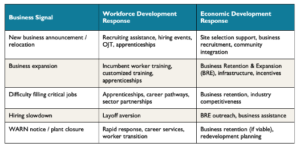
There IS a pattern: the strongest possibilities for collaboration tend to cluster around growth indicators (expansion, technology investment, industry cluster growth) and around risk signals (hiring slowdown, financial stress, WARN notices). These are the moments when a coordinated, cross-agency response matters most—and when employers notice whether the community showed up. Use these signals to identify your next outreach list and coordinate the response before the opportunity passes.
Not every program belongs equally to workforce development or economic development. Some are clearly led by one side and supported by the other. Others are genuinely shared, and that distinction helps clarify how the response should move forward:
Clear ownership matters because ambiguity causes employers to fall through the cracks—or get contacted by two different people asking the same questions. Clear roles also help teams move from overlap to coordinated action.
An engagement framework is good, but it’s only useful if it holds up against real-life business scenarios. To show how the framework works, consider these examples:
This business is making long-term investments, not just filling seats. Therefore, that’s a natural opportunity for workforce development (apprenticeships, incumbent worker training, recruiting assistance) and economic development (a BRE visit, infrastructure and utilities coordination, supply chain development) to coordinate.
Multiple weak signals stacked together tell a much stronger story than any one of them alone — and they point to exactly the kind of employer where early intervention may prevent layoffs altogether. In this case, workforce development can support ownership and workers’ skills development, while Economic Development provides guidance, resources, and access to financial support programs.
Proactive, coordinated outreach here can mean the difference between mitigating a downturn and reacting to closures after the fact.
Good targeting rarely comes from a single data point. Instead, it comes from combining signals. Start by reviewing your strongest growth and risk indicators. Then assign the next employer outreach accordingly.
Workforce and Economic Development agencies also have more internal intelligence than they realize—it’s just scattered. Internal data assets include workforce program performance data, business services CRM records, WIOA performance data, business engagement history, economic development data, UI/WARN data, employer advisory group input, staff knowledge, and success story archives. External resources — labor market intelligence, community college data, and external partner intelligence — round out the picture. Together, these sources help reveal what to look for next.
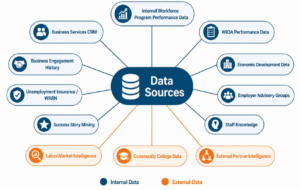
The internal knowledge sources deserve particular attention, because they’re often underused:
Once you know what to look for and where to find it, the next step is to interpret and apply it across your market. Teams can data-mine their own program history—apprenticeships, OJT, incumbent worker training, layoff aversion, and rapid response—to identify what successful engagement looks like.
For example: which employers launched programs successfully, which occupations and industries were involved, completion and retention rates, time-to-launch, and more. When applied across the broader business universe, those patterns can surface high-match candidates before they ever raise their hand.
That broader view also connects directly to how engagement unfolds over time. Use these patterns to build your target list and begin outreach. Start with the employers most likely to respond.
Successful business engagement cannot be transactional. Every business moves through stages — startup, growth, expansion, innovation, maturity, and transition — and economic and workforce development have a role at each one. Even if engagement ebbs & flows, use the business lifecycle to decide when to engage. Also, use it to decide what to offer and which team should lead.
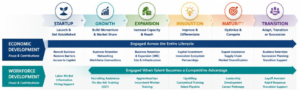
Economic development keeps engaged across the entire lifecycle: recruiting and removing barriers at startup, supporting retention and networking during growth, coordinating BRE and infrastructure during expansion, backing capital investment and partnerships during innovation, assisting with export and market diversification at maturity. At the transition stage, it also supports succession planning.
Workforce development engages most heavily once talent becomes a competitive advantage — from labor market information and hiring support early on, through recruiting and OJT during growth, apprenticeships and incumbent worker training during expansion and advancement. As businesses mature and transition, workforce development focuses on leadership development. It also focuses on layoff aversion, rapid response, and succession planning at the transition stage.
Mapped side by side, it’s obvious these aren’t two separate parallel engagement paths. They’re a single continuum of support. In fact, the handoffs between them are where partnership either works—or doesn’t. That’s why the transition between economic and workforce development matters so much.
Keep it simple, and remember just 5 guiding principles:
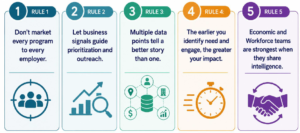
Successful business engagement is not about “your program.” Businesses don’t care about your programs, metrics, or goals. Instead, successful, effective business engagement by workforce and economic development agencies must be about the businesses’ experience with you: unified, coordinated engagement; collaboration; and community support.
Finding the right business for the right program at the right time depends on effective targeting. This means combining program data, business signals, and shared intelligence to know which employers need attention now. It also means ensuring economic and workforce development show up together. They should show up with the right message, at the right time.
This blog was adapted from a presentation by Mark Muckerman, CRO & Director of Strategy, “Targeted Business Engagement – the Collaboration between Economic & Workforce Development,” BSA 2026.
Questions about the framework, or curious about how EconoVue helps economic and workforce development organizations put targeted, signal-based business engagement into practice? Contact us.

Here is the October 2026 EconoVue Newsletter. This month, we highlight the Commo...

The Commonwealth of Massachusetts Expanded Employer Sponsor Participation Throug...
Here is the September 2026 EconoVue Newsletter. This month, we salute all workfo...

Turning Business Signals into Smarter Economic & Workforce Development Colla...
EconoVue™ is your window to business and workforce insight.
Founded in Silicon Valley in 1999, and now based in Arlington, VA, EconoVue, Inc. is a woman-owned small business with a single mission: to help our clients visualize data and gain actionable insight into the past, present and future of their local and regional economies and workforce.
Originally founded as The Urban Explorer, Inc, a boutique consulting firm designing interactive GIS tools for economic development, land use planning and urban design, we heard a common theme from our customers: “Help us analyze today and help us predict tomorrow.” We found ourselves replicating the same steps of geospatial economic analysis studies, so rather than reinvent the wheel every time, we decided to invent it just once and automate the process via a single platform, and EconoVue™ was born.
The millions of businesses that comprise the U.S. economy and workforce are constantly in motion. Our agile approach to solution design is highly collaborative with the “end-user”, constantly evolving to meet the growing needs and creativity of our clients as they try to extract insight from data chaos.
Working with our data partners, public sources and our great collaborative clients, we continue to expand EconoVue™ to meet new needs, including Economic Development, Transportation and Custom Analysis. Our design philosophy is to produce innovative, actionable data insight tools, in a modular application platform that is iterative and easily adaptive to meet the ever-changing information needs of our clients.
