 EconoVue™EconoVue™
How to Find the Best Companies to be Apprenticeship Employer Sponsors
by Mark Muckerman
After decades of partnering with Workforce Development Boards (WDBs) nationwide, EconoVue is pleased to share the 5 Best Practices on “How to Find the Best Companies to be Apprenticeship Employer Sponsors”.
We understand that finding the right companies to be apprenticeship employer sponsors is less about blasting emails and more about targeted outreach to organizations that already have the conditions, incentives, and mindset to succeed with apprenticeships.
So, if you are a Workforce Development Board (WDB) or educational institution, you cannot afford to waste limited resources on manual guesswork. At EconoVue, we help workforce development boards improve program results by using data to strategically identify the right business for the right program at the right time.
A data visualization and analytics platform is a game-changer for workforce boards.
Some sectors consistently perform well with apprenticeships because they face persistent talent shortages, high turnover costs, and clear Career Ladders.
Historically, High Priority Industries include Healthcare, Advanced Manufacturing, Construction & Skilled Trades, IT & Cybersecurity, Logistics, and Hospitality.
However, do not ignore the localized High Demand Sectors, as industry dynamics differ. To illustrate the point, an East Coast workforce focused on the Marine Trade industry, while a West Coast board prioritized its growing Life Sciences and Information Technology sectors.
And remember to collaborate. Your best leads are often already known to Industry Partnerships, workforce board employer partners, or community college advisory boards.
There is no “perfect template” for an ideal company to expand apprenticeships. That’s why innovative workforce boards are prioritizing employers that meet three or more of the following criteria:
Additionally, you can also use data filtering to tailor program outreach to specific employer subsets. Filter by minority-owned, women-owned, and veteran-owned businesses to create inclusive apprenticeship pipelines for underrepresented populations.
Not every company in a high-probability industry is a good fit. Focus on employers already showing these traits:
<li>
Look for Trigger Events
: Companies are most receptive when something changes.</p>
Even a perfect company won’t move forward without the right contact.
</ul>
The “best” apprenticeship sponsors are not just big or well-known companies. They are employers that feel the pain of hiring, already invest in people, offer career progression, demonstrate signs of business health, stability, and growth, and have leadership willing to try something new. By combining strategic outreach criteria with powerful data tools like EconoVue, you can easily cut through the noise, pinpoint healthy, growing businesses, and build a thriving, sustainable apprenticeship ecosystem.
Download the PDF version of the Five Best Practices here.
Key success measures for business engagement
by Danny Patterson
State and local workforce development boards (WDBs) lead a broad list of essential workforce programs from rapid response and layoff aversion to apprenticeships and incumbent worker training, DEI, and justice-involved, and youth programs within their communities. And that is just the tip of the iceberg. These programs involve many constituents from the community, including the business partner.
Like all publicly funded programs, a certain level of accountability is involved. The workforce system has become very efficient at calculating the outcomes of WIOA common measures, such as placement, wages, and retention.
However, measuring the impact beyond those mandated measures remains a constant challenge for WDBs. WDBs also track and report skills gains and credential attainment, which ultimately inform the above three measures.
But what about the business effectiveness measures we were to pilot? To date, we haven’t had the same level of success! In fact, the WIOA reauthorization bill that passed the House last year admitted as much and removed them stating several reasons. So, only some WDBs measure and report business engagement as a standard practice. The question is, why?
The employment and training system has always had a dual customer model – the job seeker and business. It’s supply and demand. It seems contradictory to that well-known adage that what is measured is important, yet we continue to focus measurement almost exclusively on the supply side, the job seeker.
But we know we can only make quality employment referrals for our clients with effective business relationships. Therein lies the dual customer challenge. So, what are we left with? We may collect some data points and report some numbers to the state, but they go nowhere! The feds certainly don’t publish them.
What’s needed is a way forward. The common denominator of the current measures is business. The lynchpin of any vibrant and successful workforce development program are businesses.
The businesses in a community represent the demand side of the workforce system. They also provide valuable insight into the labor market and what’s coming on the horizon. They are the first to recognize a need for new skills and can help build effective training and educational programs to respond to that need.
This administration’s focus on expanded apprenticeships is one example of a training program developed by and for businesses. It is why businesses have the majority membership on all state and local workforce boards.
If we are going to measure something, we need to define it first.

Always start with what we know – the total number of businesses registered in the system and those that have accepted referrals or are posting job vacancies. Equally important, much like the placement rate, we need to know the percentage this number represents of the total business universe.
After all, how can we tell if we are impacting the priority sectors in our local plan if we only count those businesses that opt in? It’s a simple denominator and numerator calculation.
We can only do this effectively if we have a reliable source that can tell us how many businesses there are in my state or local area and in a sector. DOL refers to this as the penetration rate. Today, we are only using the numerator!
As the tip of the spear of the workforce system into the business community, business engagement does matter. The challenge in measuring the impact of business services is that it is too hard to quantify. If you read your federal year-end report, it doesn’t show up there, so how do we show our value?
First, we know a good business services team identifies quality opportunities for our job seekers. You can easily correlate the job placement rate and the quality of those jobs to your engagement efforts. But there is another side to that equation. What’s the impact on the business? Do you know?
Business Engagement Metrics
As shown in the diagram below, tracking outcomes from the work you do every day can capture the breadth and depth of business engagement long before the “placement and wages” occur.
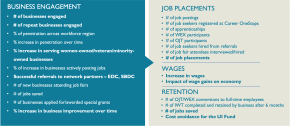
Now let’s look closer at what’s possible in measuring the progress and success of business engagement and your effectiveness in serving employers.
Measuring business engagement within your workforce system starts by first understanding the percentage of the business community you are presently engaged with and then growing that percentage year over year. Engaged means active participation, such as posting job vacancies with you, being willing to receive referrals from you, being involved on a business advisory council, or conducting sector strategies. You get the picture. Engaged does not include a company on our mailing list that gets stuff from you. As we grow that number, we increase business awareness of our value as partners and their choice to participate in the system.
They do so for one simple reason: the value it brings to their business. There are other values at play here, too – an increased opportunity for our job seekers, and if we do this well, positive word-of-mouth advertising. If a business is happy partnering with you, the business will tell others. Like you do with recommendations about restaurants, movies, wine, or cigars. A good referral between businesses is worth tons to our system. That should be our goal – valued partnerships that promote our network. What percentage of the businesses are you engaged with across your community? You can see the opportunity already!
Just like we don’t recommend bad restaurants or movies to our friends, a business seeking repeat business is an indicator of the quality of service provided by your team. Job placements are top of mind for every workforce board across the nation. It’s measured; it matters. Job creation is reported every month at the national level, and over the past months, we have seen strong job growth. Moreover, the need for a skilled workforce is ever-present. As reported in The Hill, the ratio of job openings to unemployed workers jumped to a near-record of 1.9, meaning that there are nearly two job openings in the U.S. for every job seeker.
This current workforce dynamic creates a diverse set of opportunities across your entire region – for highly skilled workers to those requiring public assistance to those just entering the workforce. And most importantly, for workforce boards, this creates an opportunity to serve both the job seeker and the local business. But where are these opportunities in your community?
98% of all businesses in the United States have less than 50 employees and represent the rich diversity of our local and state economies. Not all WDBs are using national job boards to fill vacancies. But they should be using you. If we grow the pie, we grow the opportunity and can serve both the business and the job seeker. Quality jobs, a skilled local talent pool, and opportunity – now that is a win, win, win. Job seeker, business, and you, the workforce system – the intermediary between these two customers of our system.
Many federal and state grants specifically target businesses representing certain ownership groups. And WDBs need to continually measure the increased diversity, equity, and inclusion across all programs. To do that, diversity classification data is essential to report participation across the community’s full array of businesses.
It is also important to measure the quality of your partner network. Do you refer businesses to your local EDC or SBDC for things outside your toolbox? If not, you should be! What if a business needs to upgrade equipment, have more space to expand, or grow its market share? We need our network to help and deliver when called upon. It shows the strength and commitment of your effort on their behalf because you have built this toolbox and this network of partners to provide valued services to the business community, whatever they need, that’s thinking and measuring beyond placement!
These are just a few things to consider as you consider ways to improve how you measure and report your impact and benefit to the business and the job seeker because you serve both.
Why does it matter? A quick review of the FY21-22 Annual Performance Reports shows roughly 68% of all participants retain employment after the 2nd quarter following program exit. Would a larger pool of employers, full of healthy and engaged businesses, raise that number? I say yes. It’s obvious. Do you know if you are engaging with 4% of employers in your system or 4% across your workforce area or region? The difference matters because the level of engagement is an important distinction and opportunity. But as I said above, we only know what we measure. We can and should do better.
If the foundational premise of our system is one of continuous improvement, once you know the numbers, you can better set future goals to increase the level of business engagement year over year. Grow your piece of the pie, or continuously improve.
Yes, it’s hard to move the needle. But if we look at each local area as a slice of that pie, the needle moving can happen easier.
This measure could also be a basis for states to provide incentive awards to local boards, striving to achieve positive change in this area of business engagement.
After all, what is exemplary performance? Define that in a way that pushes growth and engagement.
We measure client success, and we’ve talked about increasing the size of our business community pie. What about measuring our impact on the business itself? WIOA Final Rules tell us that we should engage with businesses at all points in their business cycle. So, business engagement is more than just placement or waiting for layoffs or mass hiring events. Instead, it is an all-in strategy!
But how can we measure impact at that level? Let’s use an example of a sector near and dear to all of us – healthcare! Do you know many healthcare facilities are in your state/local area? You should. Do you know who in that sector is driving that growth? You should because we know, in business, not all ships are rising with the tide. We need data at this level of detail to develop strategies within sectors. We have different toolbox strategies for those growing, for those stable over time, and for contracting businesses. This strategy is what WIOA and its authors intended as proactive business engagement.
Measuring impact starts with establishing a baseline before that first visit. It continues by engaging with them over time, offering quality solutions as needed. Just as a successful placement has several touch points with the system as they progress in their careers, it should be the same with our other customer – the business. As they also move through their business cycle, we want multiple touchpoints and a toolbox for each. With this approach, WDBs create a valued partnership.
If you measure these or other ways, this becomes quality information for your board, your team, and your community. This information also demonstrates how you can be a valued partner to the business.
Some innovative WDBs have taken the initiative to measure success with more granularity, even though not required. Other WDBs track economic impact through increased revenues and specific community impact measures.
Some boards calculate impact with data readily available – earnings spent in the economy. It answers the so what test. A scenario: you placed 2500 participants in jobs in FY21-22, earning a median wage of $7,500 a quarter. 4th quarter 70 percent of participants are still employed. Those efforts bring $52,500,000 into your local economy that year. That is an impact beyond the common measures.
The most progressive boards also use cost-benefit analysis and return on investment calculations. These data points inform the common measures. They demonstrate to our communities, state, and local elected officials, and board members that targeted business engagement does, in fact, feed outcomes. It does matter and should be measured. It’s about growth, and it’s about revenue and quality of jobs, and quality of life for our residents.
The top goal of every workforce board is to develop educational pathways that lead to quality jobs with secure full-time employment for skilled workers. For that to happen, you need to partner with financially strong employers with good-quality jobs. You need to support businesses through the ups and downs of their business cycle. To measure your total impact in your community, you must go beyond the common measures and acknowledge that this system has two customers. It is essential to track every business engagement and know your denominator. You need to understand your impact today and over a period of time. And understand the impact at both the business and sector levels. Use that success to tell the rest of the story.
PHOTO CREDIT Adobe Stock Photography
by Danny Patterson
Happy Workforce Development Month! I want to salute all the vital work done by workforce development professionals. This salute is well-deserved recognition. But we are not done. There is much to do to shed the unspoken honor of being one of the best-kept secrets to job seekers and businesses in our communities.
Several years ago, I attended a regional business symposium that featured a business futurist. Of the many things he said, one stuck with me and goes like this – “in the future, your children will look at you and ask, so let me get this right, you drove 1-hour in rush hour traffic, paid to park your car and spent at least 8 hours working in a cubicle on the internet?” His futuristic view was very predictive and accurate. One thing is for sure, change always arrives. Regardless of its cause – shift happens. The pandemic changed things, but not all things.
We recognized new heroes who continued to show up and provide critical services. Essential workers include grocery store attendants, truck drivers, warehouse workers, first responders, teachers, manufacturing, mail carriers, delivery service drivers, and our favorite barista team! A new term became common – essential worker. Those words surfaced an awareness in each of us – I am essential.
During the pandemic, the seismic shift to working from home allowed families to reconnect. Family and friends rediscovered leisurely dinners and great conversations together. This re-emergence of a genuine work-life balance is driving and redefining job quality and quality of life – and we want to hold onto it. It is changing the nature of work for many, but not all. As this definition takes root and grows, we have to identify the opportunities for business and the workforce development system. We must continue providing training programs that develop the right skills for our clients/job seekers to succeed in virtual work and in-person services. Not just for the jobs of today but also tomorrow. In addition to work-life balance, what are some other workforce trends creating this shift? A few observations.
All things “green” creates tsunami-sized waves across the economy, from energy production to manufacturing and Infrastructure. Consider the changes within the transportation sector as one example. State and federal mandates are forcing dramatic changes in the transportation sector, and these changes are dramatically impacting the energy and infrastructure sectors.
For example, new rules in California now require that “all” new cars sold in the state be free of greenhouse gas emissions by the year 2035. It includes interim targets – 35 percent of new passenger vehicles sold by 2026, growing to 68 percent by 2030.
Within the next decade, this mandate will drive (excuse the pun) change across the globe. It’s clear that if you want to sell cars in the largest auto market in the U.S., you will have to change, and that change will impact the current and future workforce, and the wave will reach many shores.
To this point, Ford Motor Company recently announced significant layoffs to make this transition from gas to electric vehicles (EV). They will have to, and so will all the others, nationally and globally, if they want to sell cars in CA. Already, the state of Massachusetts is considering following California’s lead.
In tandem, the energy grid and production systems will have to be updated and grown to accommodate the need to charge all our EVs! Stanford’s recently published study provides insight and analysis on the impact on the electrical grid resulting from this shift. My observations during a recent multi-state trip confirmed this. Where would we all recharge if more cars on the road were EVs? It’s obvious!
The transportation sector is driving change in our economy’s energy and infrastructure sectors. The shift is already happening!
Considering the change that is quickly approaching, the challenge to the workforce system remains unchanged. The national and local system collaborators, including our business partners, are tasked to attract job seekers and prepare them to succeed in today’s and tomorrow’s jobs. It’s that cliché, Think Globally-Act Locally. That’s our workforce system.
The incredible work already accomplished and being carried out today can be seen by a simple keyword search in your favorite search engine. However, more is needed. You might say that we are only just beginning. New pathways and deep collaborations are needed, nationally, regionally, and locally, where the services touch and impact our clients – the job seeker and the businesses in our communities—all companies, not just the large ones we can all identify.
To do this work well, we need to leverage what I think is our greatest system asset – our business partners. They are the majority on each state and local workforce development board, and there is a good reason for that! Business partners represent priority sectors and employment opportunities in our local and regional economies, the jobs of today and tomorrow. They also represent that economic shift – present and future. And they can help us see it and plan for it. We know many are already responding to it so they can stay open for business.
We do our best work together, whatever the sector or the amount of shift. Let’s engage our business partners in a meaningful way. Listen to their needs and then respond. To me, they are our system’s business futurists.
PHOTO CREDIT Adobe Stock Photography
by Danny Patterson
I want to share some revealing insights from a collaborative coaching session with EconoVue, Business U, and a state-wide customer. It was a fascinating session focused on the importance of Data-Driven Business Engagement and Strategic Communication, led by Christine Bosworth, CEO of Business U, Inc.
Optimal business engagement is both art and science. Let’s break this down, starting with the easier of those two. Surprisingly, that’s the data science behind business engagement. The amount of incoming data available has become overwhelming for most, making it difficult to derive the necessary insights that enable you to act or implement a comprehensive strategy. The right business engagement tool with predictive analytics can reveal actionable, forward-looking insights into a company’s financial health in seconds. Literally with just a few clicks of the mouse! For example, you can determine if a business is expanding, stable, contracting, or at risk. This insight alone accelerates business engagement.
Now let’s explore the art of business engagement. And this is arguably the more challenging aspect to get right. We know from experience the first message will resonate and generate a response, or the business will ignore the message. That cliché, first impressions are the lasting ones, applies here. So, what can we do to improve the response rate? It all starts with the art of conversation. Too often, business service representatives struggle to know how to engage with a company. As a result, they may lead with their agenda and, worse, not speak the language of business. Here are four steps from the coaching session to remember in your next interaction.
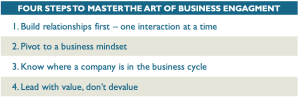
The first rule of business engagement is to build relationships with businesses – one interaction at a time. And every relationship requires interaction – lots of interaction. Building a relationship with a business takes time and effort to earn trust and establish credibility. Once you have that trust, you can become a valued partner in the company’s journey.
How do you get started? Quite simply, by getting to know a business. Do your homework. Check out the company website first. Most of what you need to know is right there. What’s their mission or corporate charter? What do they do? Do they have any emerging needs or pain points? Local news or economic development agencies can also provide information about businesses. But know this, a business owner is too busy to explain what you should already know. Your initial investment of time will pay dividends.
According to Business U, some simple tactics include but are not limited to following what’s happening via:
• Company newsletters and social media channels
• Relevant sector newsletters, such as manufacturing, hospitality, retail, etc.
• Google alerts about company updates, launches, and industry trends
• Industry conferences, award programs, and local events where businesses gather.
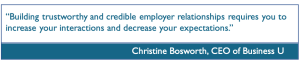
Repeat this strategy for every business in your community because knowledge provides the opportunity to establish a relationship. The most successful people in workforce development build strong relationships by dropping their agenda and increasing their interactions. Results always follow.
With every interaction, there should always be a call to action. First, decide what type of communication – will it be one-to-one or one-to-many? Next, decide on the call to action. It might be to invite the business to a live event or webinar. Or meet with them at their place of business. Perhaps you want to inform them by downloading an article to read. Think about what’s the next best step for them. But most importantly, always communicate what’s in it for them.
I can’t say this enough – know your audience. When engaging with a business, talk about business, talk about what matters to the business. Be careful not to approach a company simply as an employer. That is only one facet of what a business does. Focus on their business holistically and understand their charter. Communicating the value to the company, not program features, is highly effective.
Remember, it’s not about your core services, but starting from what they might need from you that adds benefit to them. If you go in with your list of services, they may not need them. So, what do you do then? Fold up your tent and go home. That’s a relationship opportunity lost. If you listen first and work to establish a relationship with them, by thinking long term, perhaps not provide a solution today, but you have left an impression on them. They will believe this is someone who cares about my business. A resource to keep in mind for the future.
Always approach a business with its agenda in mind, not yours. Ask about the business goals. Are they looking to expand, increase cash flow, improve productivity or retain or attract new talent? What keeps them up at night? Only then, after listening, can you propose a potential solution that brings value and benefit to the business. That’s how you build a strong relationship.
Always know where the business is in its business cycle before you engage – that important detail will inform your communication strategy. In its simplest form, the business cycle spans the entire spectrum from early stages to growth/expansion, stability, and decline. It is important to note any company that has been around for years may move back and forth through these stages. It is not a straight line from opening to closure.

The business cycle detail will tell you that they may need larger spaces or recruitment services if they are a growing organization. Stable businesses may need upskilling support. Alternatively, declining businesses may require rapid response, while closing companies may need help for impacted employees with rapid re-employment. Knowing where a company is in the business cycle enables targeted outreach to those most receptive to your message.
It is also essential to understand business trajectories can and do change from quarter to quarter, so specific and targeted messaging is critical. For example, you don’t want to discuss employment for your job seeker/client when that company is downsizing or propose layoff aversion strategies when expanding. Using a robust business engagement tool such as EconoVue’s, which leverages the comprehensive Dun & Bradstreet business database, generates outreach lists based on their business cycle. This insight is like having a hammer and a nail – they just go together. Remember, use actionable data, gather knowledge, message, listen and respond with a solution that adds value.
One of the biggest mistakes workforce professionals make is devaluing their services by leading with the word FREE. Some might associate “free” as it has no value. Businesses do not easily understand free because they are used to paying for services they need. That is unless you tell them WHY it is at no cost to them.
Here are a couple of examples of how to explain no-cost services. Our workforce experts leverage federal, state, and local funding sources and pass that savings on to you. Or, we offer financial resources to support business growth and expansion. We help businesses with a variety of proven and effective employee retention strategies. I’m sure you have some of your go-to-phrases and would love to see them in the post comments.
It’s always best to lead with quantifiable business benefits. Tell them what’s in it for them. We can help you improve cash flow with access to capital. Increase productivity by 10%. Improve retention rates by 20% or cut HR costs in half. And so on, you get the idea. That relevant value proposition will resonate with the business and capture their attention.
Every interaction is an opportunity to move your relationship forward. Know the sector. Let them know you understand their business and where they are in the business cycle. Engage in a dynamic conversation and pivot as necessary. Show them by your actions that you are an informed and active listener first. Use your toolkit to bring the right solutions to the table. Connect them to the right resources. Leave an impression on that business. And finally, make an impact on the company that will resonate with the community.
Remember, once you have a strong working relationship and positive impact on that business, don’t hesitate to ask them for a quote. Ask the organization for some quantifiable benefits you have helped them achieve. A testimonial from a happy customer is precisely the type of third-party credibility that creates future success.
That is the art and science of business engagement.
If interested in learning more, reach out to EconoVue to accelerate business engagement with a powerful data visualization tool and Business U to maximize business engagement strategies.
PHOTO CREDIT "Business Meeting" by thetaxhaven is licensed under CC BY 2.0.
"Business Meetings" by thinkpanama is licensed under CC BY-NC 2.0.
by Danny Patterson
Before we get too far in, let me first answer your question. The Trade Adjustment Assistance Act (TAA) is a federal entitlement program that provides various services and supports to U.S. workers may lose their jobs or may be impacted in the near future because of foreign trade. TAA has been an integral part of foreign trade acts since 1962 and has been amended numerous times over its 60-year life. That is until June 30, 2022.
On that day, the program was allowed to sunset. The program will no longer consider new petitions by affected workers for services. That’s a big deal. Almost 5 million workers have been certified for services throughout this program. How did we find ourselves here? Simply put, Congress did not take one of two necessary actions to continue the TAA. They did not (1) allocate funding through a legislative vehicle to continue these services under existing law or (2) pass legislation with accompanying funding that recasts the TAA program to increase outcomes for beneficiaries.
TAA is a great program that requires immediate reauthorization. However, with all things involving bipartisan agreements, there is uncertainty about when the reauthorization will happen, given other congressional priorities, summer break, and upcoming mid-term elections. Good public policy takes time and energy, but it also must be balanced with the impact on these communities, their workforce, and families.
Global trade impacts large metropolitan areas and the small towns and cities that dot the Midwest and South and affects thousands of workers each year. One recent example highlights a plant closure in Ohio and how the sunsetting of the TAA program impacts their immediate futures. The ending of this program, even if temporary, represents a significant hit to these workers and their communities. There is work to do at the federal level to pass this needed legislation and at the local level by our workforce system to respond to this change.
That’s the hard-to-hear news, but as with all coins, there is another side to the story. The good news is that Workforce Development Boards (WDBs) can quickly pivot to other strategies, programs, and resources available to assist these dislocated workers in short order. And do what you always do – develop partnerships and new service strategies to leverage existing resources to support these impacted workers. Here are my recommendations.

Business conditions can change unexpectedly. Regularly engaging with manufacturing companies is not only the new normal but a business imperative. As one manufacturer is contracting in your community, you must be aware of the financial condition of the other manufacturing companies in your jurisdiction.
For example, are they growing, and are they hiring? A strong partnership with local manufacturers allows local WDBs to quickly find new employment for these dislocated workers. Using existing skills ensures there is no disruption in employment and minimizes the impact of the layoff on the affected workers.
A strong partnership with manufacturers allows you to keep pace with what’s happening within the company. It also puts you in a better position to suggest or develop new reskilling programs to train employees to adapt to different positions within the company or learn new skills to use updated equipment.
The opportunity to work with education partners and industry to help these workers learn a new skill or find a career pathway creates a more versatile employee – one that can make them more marketable now and in the future.
With the new fiscal year upon us, there is a new allocation of funds available for IWT strategies. The IWT program is an effective business solution that helps the company retain its workforce. This program also upgrades skills to keep the company and its workforce competitive in the economy.
A common strategy for layoff aversion is rapid reemployment. This is the effort to quickly place dislocated workers back into the labor market with growing and healthy companies. Rapid reemployment grants can support the training of those who have experienced employment interruption and put them in high-demand jobs.
Access to workforce training builds the necessary skills required for in-demand jobs to get people hired quickly. A grant program such as this plays a critical role in getting the workforce back to work.
Enrollment in a training program valued by the business community is another great strategy. WDBs should evaluate where the skills crosswalks are and validate the training programs with the business community. Also, WDBs should work with their education partners. These programs must be available to those workers who will not return to work in the manufacturing sector.
MEP program emerges as a strong ally for the WDB. MEP is a public-private partnership funded by the Department of Commerce. With Centers in all 50 states and Puerto Rico, MEP serves small and medium-sized manufacturers.

MEP Centers and partners enable manufacturers to identify opportunities that will accelerate and strengthen growth. This in turn creates competitiveness in the global marketplace. The MEP Network offers a wide range of business improvement, business growth, and risk mitigation services and initiatives.
One other, often overlooked partner is the local utility company. Are they in your toolbox? Manufacturing companies use a ton of energy. These new partners can identify ways to reduce operating costs by installing energy efficiencies. Also, they may offer special pricing programs for the short term. I’ve seen them do creative things for businesses. Now we should bring them to the table as part of a global solution.
I recently read a startling statistic. Of the 5 million workers certified for TAA services, only half of them received some direct benefit through the program.
In the absence of new legislation, the national workforce system should evaluate its relationship with the manufacturing sector. We need to work together to support the small to medium-sized manufacturers which are a critical economic base and:
We cannot wait for Washington when we all need to accomplish this work now. These impacted workers are relying on us, now more than ever.
PHOTO CREDIT "Wagner Pizza production line" by Nestlé is licensed under CC BY-NC-SA 2.0.
by Danny Patterson
Significant improvements to WIOA are on the horizon – and as of last month, we are one step closer. On May 17, 2022, H.R. 7309, the Workforce Innovation and Opportunity Act (WIOA) of 2022, passed out of the House of Representatives and now awaits action by the Senate. This bill aims to reauthorize and strengthen the primary federal law—the WIOA of 2014—governing the nation’s workforce development system. Here’s my take and commentary on a few aspects of the bill.
From my Point of Vue, one sure way to assess the intended changes is to examine how definitions are updated. These definitions add focus to the programmatic shifts included in the legislation. HR 7309 is true to form.
Here are a few highlights through this particular lens:
These are good, worthy things to work on collectively as partners.
The other lens to consider is the anticipated changes in the area of governance. In other words, what structural or strategic changes are necessary to help guide the system towards achieving this new vision. First, as always, is funding. WIOA authors do not disappoint They:
That’s a lot, and it represents only a few of the shifts in focus.
My four key takeaways focus on job quality, new and expanded programs, improved planning, and business engagement. First and foremost, laid over all these definitions and structures is a focus on job quality. Or, to say it another way, those with competitive wages, benefits, and safe workspaces. Those quality indicators show up in the changes to performance measures.
The bill also affirms the workforce system is not a work-first strategy but, at its best, is an employment and training program whose systemic focus is on quality jobs and career pathways that lead to self-sufficiency. It outlines necessary and robust changes, provides new clarity and accountability, expanded programs, and calls for more diversity across programs. Added to that strategy are more meaningful business engagement and improved planning.

One straightforward way to improve the record on job quality is to engage with employers that are also healthy businesses. Employers who are financially stable or growing are more likely to invest more in their employees and provide quality jobs, which we should work with to fill with our skilled and job-ready clients.
The additional performance measure at the 12-month mark after exit is a crucial indicator of a quality relationship between the business, job seeker, and the workforce system – and demonstrates their added value as an effective intermediary between the two.
The legislation also makes some positive moves for summer and year-round employment for youth, incumbent worker training, transitional jobs, justice-involved programs, older workers, and gender-based violence victims.
I think we can borrow an old sales cliché – more positive leads generates more sales. The best place to start these strategies is with healthy companies. Whether for youth, incumbent worker training, or any priority groups of job seekers, this strategy all rests on the statement that quality jobs are in quality companies. These new areas of focus go beyond our placement strategy and require new thinking and the formation of new relationships with businesses. The challenge is whether your system serves a rural or urban setting, large or small; we need to be able to identify and expand our message to those who haven’t yet heard it and will receive and act on it. Regardless of the strategy, the message must communicate benefits to the employer.
We must be able to deliver on our promise of quality to our dual customers. Successful engagement and quality outcomes can then involve employers (large and small) in sector strategies as invested partners with the education community developing quality on-ramps and IWT programs. Nothing is better for our system than a positive endorsement from a satisfied business partner.
We know quality information is key to an effective outreach strategy, regardless of the reason or community served. Expanded programs and more employer engagement will undoubtedly result in more quality jobs for job seekers and skilled workers for employers. That’s a win, win strategy.
WIOA of 2022 outlines fundamental changes for state and local plans, requiring both to take a broader view of current and future economic shifts.
The new legislation requires states to consider in their economic analysis:
To meet this need, state boards may utilize other sources of data besides BLS occupational or industry projections to identify long-term trends not captured by one source of data.
Local plans should analyze regional economic conditions, including:
Moreover, local boards shall have a standing committee, which shall be representative of workers and their communities. They shall provide input and assist with responding to rapid economic changes. Changes include layoffs, a rise in unemployment, and emerging opportunities for in-demand skills and competencies.
The economy can change quickly and, sometimes, unexpectedly. WDBs should take a broader view beyond BLS data. They need to seek information from other business partners to simplify their planning efforts.
Evident throughout the new legislation is a recurring theme of a stronger focus on employer engagement.
Business engagement is key to improving access to jobs in high-skill, high-wage, or in-demand industry sectors and occupations. It is also crucial for expanding employment and career advancement opportunities for workforce system participants in those sectors or occupations. This bill invests in employer engagement by authorizing funds for local boards to convene and develop industry and sector partnerships. Ask yourself:
WIOA of 2022, if passed through the Senate, will create positive momentum for job seekers, employers, and WDBs. These proposed shifts are significant and seek to serve those most in need. Our task is to prepare them for that career. But the State leadership and local boards must strive to fully implement WIOA if enacted. Otherwise, it will simply recast historical practices with new names and faces. I am confident the desire and talent are in place to make positive change that impacts people’s lives. After all, that’s why we are all in this business.
PHOTO CREDIT: WIOA LEGISLATION, WWW.CONGRESS.GOV
Small Businesses are also the Unsung Heroes of the American Workforce
– by Danny Patterson
May is Small Business Month. It’s time to salute all the small businesses across America. I am in constant awe of their vision, courage, resiliency, and commitment to their dreams. Small businesses are our economy. They are the backbone and heartbeat of America. As a workforce system, we need to keep the vitality and diversity of our local economies alive through our positive actions toward local small businesses. So, with all those accolades, one can only wonder why they are not a top priority of Workforce Development Boards (WDBs) across the country.
The obvious question is, why should small businesses matter to your WDB? Did you know that companies with less than 50 employees:
Small businesses are cute mom-and-pop shops, and we feel good about supporting them. But WDBs must remove that preconception and recognize small businesses are not only contributing to our communities; they are driving it. That’s right! They are the driving force.
One common misconception is small businesses are small, but there is nothing small about small businesses. Small is only a designation of size, not their impact on America’s economy. One of the surprising takeaways from the recent NAWB Forum was the lack of focus on small businesses.
Did you know 98% of all companies in America have less than 50 employees? And these businesses employ more than 50% of all workers? Even more interesting is that 75% of most sectors are small businesses. When you see those stats, I’m guessing your reaction was the same as mine – no way!
Small businesses are companies with less than 50 employees and represent:
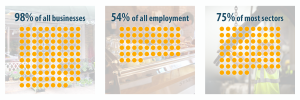
Surprising and impressive, right? Now, think about their positive contribution and impact on the workforce, the community, and the overall economy. Without small businesses, we would be half of what we are today.
Small businesses juggle multiple priorities every day – having enough working capital to keep the doors open, finding new customers, growing their business, and hiring qualified job seekers. But now, they are up against some trends entirely outside of their control. For example, the impact of COVID has had a long tail. The great resignation/reshuffle has created a labor shortage. Inflation and fears of a recession are worrisome. And on top of all that, they are invisible to the workforce boards. We know this because we had to work hard to find them and then provide economic relief grants to these same struggling businesses. Let me ask you, what have you done with them since? How have these relief grants impacted them? We should know! We are investors and partners with them.
Shifting dynamics – The retail WARN notices in 2020 for temporary layoffs weren’t temporary. Small businesses with more than 50 employees now employ less than 50. Moreover, the retail shops in the 10-50s segment have now shifted into the less than ten employees bracket. These shifting dynamics are not limited to the retail industry. Small businesses have gotten smaller. We see this too in our communities. As the economy is opening up, some small companies have posted signs such as: please be patient – we’re currently understaffed. As a customer, I thank the people working in these shops for showing up. Yes, I will be patient. And thank you for being here.
Underserved training needs – With the current labor shortage, companies need to scale up with the trades. We all understand that need. I see infrastructure projects that seem unending because of the labor shortage. For years, there has been an ongoing national conversation around this challenge, which continues today with the focus on increasing apprenticeships. But in many cases, those are reserved for large companies and union shops. While there are some successful new models, small businesses don’t have ready access to apprenticeships. Others may not have the bandwidth to provide the ongoing training and administration to support these training models. There is also the continued discussion regarding the connection between education with employment. But is that connection lost on small businesses? We need training programs linked to the jobs in your jurisdiction – to meet the needs for a skilled workforce in the economy (hint: that’s small businesses).
Do you have the proper training programs for small businesses in your community? We have heard the term, reimagine workforce! What would happen if you reimagine your strategy to support small, minority, disadvantaged and disabled veteran businesses as a critical element of our strategy? Imagine that!
No seat at the table – Small businesses are also not as involved in the conversations with education organizations about the skill sets they need. For example, in Los Angeles, small companies with less than 50 employees in Health Care are driving the growth in that growing sector. As you develop these sector strategies, ask yourself who is sitting at your table and why? Are the small businesses driving the growth in your area included? WDBs make daily decisions that impact small businesses by developing training programs, sector strategies, and competitive grants. As stated above, they make up 50% of employment, so who is at your table? Let’s invite them to the table, and ensure your WDB represents your community and your initiatives include small businesses.
Financial stability is not stable – Healthy companies are critical for measuring the success of our efforts to support job seekers. The three standard measures – placement, wages, and retention – rely on healthy companies. Do you know the health of the businesses (large and small) in your community? Do you know who is expanding? Who is stable? Who is contracting? That’s an essential aspect of targeting small businesses. WDBs can support small businesses across the entire business cycle – from growing and hiring to stable and considering a potential expansion. The other side of the strategy is to work with struggling business that wants to stay afloat and would benefit from early intervention from this system. Early intervention can help them avert layoffs. WDBs: Become the unsung hero in your community – and focus on small businesses!
I understand why WDBs are attracted to Amazon, Walmart, large manufacturers, and the like – they’re big, and they employ and churn through many people. Almost half of everyone employed is in these companies. That certainly makes their job much more manageable. But small businesses are the heartbeat of America, defy the odds every day, and employ the other half. Therefore, who is helping them get the qualified workforce or services they need?
My ask to WDBs is to ask not what you can do for the larger organizations but ask what you can do for the small businesses – every day. Those are places we go to lunch and dinner, enjoy a night out, or go to purchase something for the garden. Let’s honor them this month and support the vision, commitment, diversity, and vitality they bring to our communities. Let’s commit to making them a critical element of our strategies year over year. We need small businesses to come back as often as they need WDB support to help them succeed.
PHOTO CREDIT: "CLIFTON SPRINGS NY ~ MAIN STREET ~ SMALL TOWN" BY ONASILL ~ BILL IS LICENSED UNDER CC BY-NC-SA 2.0
SALUTE OPEN: "Come in we're open #sign #nyc" by vanou is licensed under CC BY-NC-ND 2.0.
SALUTE INTRO: "B&H store hours in NYC" by HVargas is licensed under CC BY-SA 2.0.
BUSINESSES: "Storefront New Leaf" by Atelier Teee is licensed under CC BY-NC-ND 2.0.
EMPLOYMENT: "Cafe Grumpy" by Scott Beale is licensed under CC BY-NC-ND 2.0.
INDUSTRIES: "Construction worker for the Panama Canal expansion project" by World Bank Photo Collection is licensed under CC BY-NC-ND 2.0.
SALUTE CLOSE: "Come in we're open #sign #nyc" by vanou is licensed under CC BY-NC-ND 2.0.
Moneyball: How predictive analytics accelerates business engagement for Workforce Development Boards
– by Danny Patterson
As the baseball season kicks off, I realize that WDBs can learn a lot from baseball and their Moneyball approach. This approach is a classic example of predictive analytics in action. Let me explain.
In the old days of baseball, scouts focused on the usual statistics—batting average, RBIs, stolen bases, and their utility in the field. However, that all changed with the Moneyball approach made famous by the Oakland A’s and their general manager Billy Beane in 2002.
The premise behind the Moneyball theory is still player analytics. But it only considers two key data points – a player’s batting average and their on-base percentage – as predictors of their true potential for winning baseball games. Essentially, Can a player hit to get on base and create runs? After losing some star players, Beane’s team-building approach changed the whole game. It also led to a 20-game winning streak (2nd longest in the modern era) and clinched the American League West playoffs. Today, most teams leverage predictive analytics in the same way to fuel their winning strategies.
So, what can WDBs learn from this? We know analyzing data is nothing new to WDBs. They still look to answer these fundamental questions – Who is looking for a job? Who is hiring? Is there a skills match? However, it is a game-changer for those who leverage the power of predictive analytics for accelerating business engagement. Surprisingly, however, WDBs often do not understand the importance of or do not have the data to identify healthy and growing businesses in the hiring equation. Business health is as vital to job quality as an on-base percentage is to scoring runs. Both are winning formulas.
Adopting predictive analytics requires a mind shift that leads to improved performance. By using three simple strategies, WDBs/OneStop Operators can:
As in baseball, a team needs the ability to predict a player’s batting average. Target the ball with greater precision and speed to increase on-base percentage. And succeed by making the most runs to win the game.
In the movie, Beane calculated correctly that a catcher with good predictive scores could be a great first baseman long before the player realized his potential. Also, in that position, the player would help the team add to the win column. I recognize the same hesitancy for WDBs, who have been doing great work for years. They often do not realize the potential for even greater success can be achieved through actionable, predictive business insights. All sports enthusiasts know an excellent regular season is not the final goal but a first step into the pennant races and towards a place in the World Series. That’s the goal! The only way to get there is to play championship-level baseball all year. Similarly, the negotiated performance goals are not the ceiling but the floor for WDBs. This shift requires the use of Moneyball strategies.
Today, WDBs rely on BLS Data for strategic planning. The Quarterly Census of Employment and Wages (or QCEW) is insightful for sector breakdown by NAICS codes and salaries. Still, it is aggregated Employer Data. It is not available at the business address level for targeted outreach.

WARN Notices are also available through the states’ Employment Security Agency and are address-based. But WARNs are only filed by companies with over 50 employees. Did you know that it accounts for only 2% of all businesses and predominantly spans just three sectors: manufacturing, healthcare, and the public sector? Moreover, only a tiny fraction of these businesses ever submits WARN notices. As a result, poor company health is only evident in layoffs or closures.
Online job sites, another employer-based data source used by WDBs or OneStop Operators, represent only a fraction of companies hiring in the community. They are voluntary and self-selected. The number of jobs they post is not a way of calculating a company’s financial well-being.
First and foremost is the ability to drill down from the sector level to the business address level. Secondly, understanding a company’s financial health and its position in the business cycle is integral to accelerating successful business engagement strategies.
The Moneyball approach is in full effect once a WDB understands the current and future state of an employer’s financial health. For example, there is immense value in understanding who is expanding, stable, contracting, or at risk of failure. This should be done before targeted business outreach.
Business expansion, contraction, and failure risk are three health measures derived from performance and data signals. They help predict a business’ change in financial position.

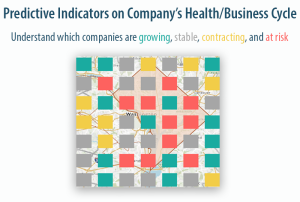
WDBs across the U.S. deploy various outreach strategies – and require predictive insights to pinpoint your targeted list. Some comprehensive address-based databases capture all the 17.5 million businesses in the U.S., but not all come with any means of filtering through the millions of records.
Filtering by size alone is not enough. Did you know that small businesses with 50 or fewer employees represent 98% of all businesses? Conversely, searching by job postings, which are self-selected businesses participating in that forum, represents a small sample of the companies in your community. Neither of these methods is performance-based and offers no meaningful insights.
A multi-layered, flexible filtering system can overlay critical search criteria such as location, sector, size, risk, growth, and diversity. This level of insight enables rapid analysis and decision-making in seconds. More importantly, you can target the right business and contact with the right message for a more successful outcome. Imagine how your batting average and on-base percentage will improve if you know the pitcher’s condition. Consider the runs scored if you understand the company’s financial condition and who to contact before your first call. Imagine if you know who is:

Understanding business dynamics is essential to accelerate business engagement. I’m confident that tracking business conditions within your priority sectors are equally, if not more important than knowing what those priority sectors are. For example, if the manufacturing industry is growing, does it mean all businesses within that sector are? No, it doesn’t! Therefore, knowing which companies are driving the growth and who are not will help you play at a championship level all season long. We know job placements in healthy companies increase the potential for future successful engagements, improve wages, increase retention, and a greater possibility of the employee entering a career pathway.
Using the Moneyball analogy, predictive data enables you to look across the league (state, region, local area, and all sectors) as well as show who is growing and the opportunities for engagement strategies. Just like baseball, you can set a winning game plan for each.
Access to a comprehensive business database and predictive, forward-looking indicators results in rapid analysis and action within seconds. Specifically, predictive analytics enables:
As a WDB, you always want more job seekers to get on base and score. Or, in layman’s terms, get and keep a quality job. Predictive analytics can improve what you’re doing already by helping you be more efficient and effective, yielding more significant outcomes.
How do WDBs measure success? Here are just a few examples:
Bottom line, WDBs are the designated hitters for meeting business needs.
Predicting a company’s financial condition accelerates business engagement. As a result, there are more quality job placements and improved outcomes across the system. That’s playing championship baseball year-round – for the WDB, the job seekers, and the businesses within the community.
PHOTO CREDIT: "Ball Impact. UNF Baseball vs. Florida Gulf Coast University" by DeusXFlorida is marked with CC BY 2.0
Not all data is actionable. There is labor market data. There is business data. And there is predictive business data, which accelerates decision making and action for WDBs.
– by Danny Patterson
We live in a data-driven economy, where there is simply no shortage of data to navigate through – from labor market information, job listings data, workforce data to business data. Each source represents opportunities and challenges for workforce development boards (WDBs).
WDBs are often unsure of what data or a combination of data to leverage to get the insights they need. Or unsure of which data to pull in first for analysis to determine the best path forward. Some only use labor market information with its 50,000-foot birds-eye view of what is happening in their region. But you can’t see the road signs or warnings ahead essential for a smooth trip.
Some take a narrower path, focused solely on the job seekers and job postings from their Wagner-Peyser labor exchange system. While others travel by country road using job listing data as a proxy for a growing business. Each pathway mentioned contains unanticipated congestion, potholes, and the potential loss of their GPS signal. We all have had that experience, and it’s frustrating.
WDBs are best served by using actionable, predictive business data as GPS to point them in the right direction to understand business dynamics.
Instead, in my view, WDBs are best served by using actionable, predictive business data as GPS to point them in the right direction with all the signs and indicators better to understand the dynamics of every business in the community.
Local Workforce Development Boards (LWDB) within a designated region must jointly perform a regional economic analysis and separate but equal analysis for the LWDB strategic plan. While the strategic plan is essential, the underlying data is even more so.
That said, local or state WDBs are overwhelmed by so many spreadsheets and data points that it confuses them into doing nothing or less than they should. Or underwhelmed by the insights that a 50,000-foot level view can derive. Both situations are understandable. But can one truly understand a business from way above? Or know what to do or how to engage in a meaningful way from that viewpoint? The simple answer is no. We all have data. Tons of it, but can we act on it without additional analysis and insight? And this is the challenge for every workforce agency.
All WDBs want is simply data to chart the best path forward. I contend “simply data” is not of any value. But actionable data, presented simply, is of great importance to WDBs.
Workforce Boards will agree unanimously that most of their data is not actionable. Moreover, even though most workforce professionals are not economists, they are responsible for understanding the economy’s conditions. At its purest, the economy is about businesses, locations, jobs, and keeping people employed. Understanding the economy relies on street-level business insights mapped to occupations and jobs data. Imagine if your data could reveal the dynamics inside a priority sector like healthcare or manufacturing. Identify businesses driving the growth and the specific occupations at those businesses, who is stable, and who is contracting? Such data would allow you to develop three distinct engagement strategies for that sector. That’s impact. That’s what actionable data can do for you.
Actionable data has five dimensions. Data must have the ability to be easily filtered for decision-making and action and be separate from the vast amounts of the workforce, economic, and business data available.

Put simply; actionable data empowers WDBs to:
Two primary data sources inform WDBs. They include labor market data from LMI and predictive business data from Dun & Bradstreet/EconoVue. While both are excellent data sources, their effectiveness depends on what you want to accomplish. For example, LMI provides a birds-eye view of a community workforce for strategic planning. In comparison, D&B offers a street-level view of community businesses for targeted outreach. The other providers that serve the WDB market also use LMI data.
WDBs benefit best from using a data visualization dashboard that integrates both to accelerate decision making and action. This matrix below highlights the actionable insights available with a dual approach.

LMI compiles statistical data based on surveys. Labor market data projects the changes in the industry and occupational employment over time resulting from industry growth and technological change. For example, the State of California produces long-term (10 years) employment projections every two years for the State and local areas.
Labor market data provides information to WDBs on the workforce population (skills, demographics, education level, etc.) to understand their workforce compared to business needs (skills, credentials, etc.). This insight allows them to develop training programs to meet the demand. The challenge is to develop programs and ramp them up before the criteria and job criteria change.
LMI is expansive in scope and ideal for strategic planning amongst individual groups. Groups include job seekers, case managers, employers, economic development, education partners, workforce boards, etc. LMI is your go-to resource if you need a high-level overview of employment and wage information over time.
LMI data, however, has its challenges. First and foremost, the data is not truly “actionable” since it is aggregated and developed through surveys. Secondly, the data represents a small fraction of the larger business community. And finally, it only offers a point-in-time sample of large companies. It does not allow real-time or forward-looking views to identify targeted businesses for outreach and engagement. For these reasons, you simply can’t make decisions with LMI data.
Therefore, LMI data is best for broad and overarching strategic planning (e.g., healthcare is a growing sector in all local workforce areas), not targeted outreach where specific and actionable data is required.
When it comes to a genuinely actionable data source, WDBs should leverage up-to-date, predictive business insights from Dun & Bradstreet; all mapped on EconoVue’s intuitive dashboard. WDBs can quickly see a path forward and accelerate decision-making with this tool. WDBs can know what is happening in their local areas with a street-level view of your business community. Understand the health of businesses in your community – who is growing or struggling for more targeted outreach. Reach the right contact at the companies for that outreach. Know what sectors are growing or shrinking or what occupations are expanding. All of these insights result in immediate action for WDBs.
This powerful dashboard offers a variety of views – employment by state and LWIA, employment by sectors, business view of financial stress and material change, and designated regional or local map views with links to specific industries, companies, job listings, and contact information.
All data offers perspective. Only actionable data points you in the right direction with these insights:
This type of actionable information enables you to initiate an informed conversation and targeted engagement strategy with each business. It enables the successful implementation of a proactive engagement strategy. As a result, WDBs can achieve and exceed their performance goals and positively impact people’s lives while serving the businesses in your community.
Workforce development professionals who leverage actionable data in a multi-layered filtering platform can know the best path forward in seconds. Actionable data in an intuitive dashboard is a GPS for WDBs as it provides a clear direction to get to your destination. That destination could be a proactive business engagement or informed prospecting for rapid response or a struggling business.
WDBs can benefit significantly from an interactive dashboard that quickly filters the millions of businesses in the U.S. based on designated region, business health, sector, or other criteria – and pinned on a map to fuel rapid decision making.
WDBs should not get lost on the highway of analysis paralysis. Or meander their way to destinations with paper maps. Spreadsheets are like a traffic jam, stuck for hours with no way out. This GPS approach is a game-changer for WDBs. This dashboard allows precision in determining who to call or visit and why. It speeds to a destination by driving the right strategies and zooms in for more street-level business information.
Actionable, predictive business data is your GPS. It is where the rubber meets the road. This approach is how WDBs can transform their workforce development plans and strategies into action and results. The best plans show us where we want to go and the best way to arrive at our destination.
Simple ways for WDBs to achieve more effective, targeted outreach
Workforce development boards (WDBs) support the economic vitality of the businesses in their communities. Therefore, it is critical for WDBs to keep pace with the changing economic dynamics in their local and regional community, so they can do more effective, targeted business outreach.
Prospecting, business outreach, and messaging, when done right, are key to any WDB’s success. But WDBs are either challenged by too little or too much data, data that is out of date, or worse, not having the right data to know who to reach out to first. Additionally, they are always running against time providing rapid response services, layoff aversions or disaster recovery efforts to businesses. These urgencies require the ability to rapidly and accurately assess the current state of a business prior to contact. Understanding the business health of a community – is a business growing, stable, or contracting – offers the right context for a conversation with a business. Bottom line, workforce development professionals are not data scientists or marketers and struggle to do both. This is where informed prospecting comes to the rescue.
Informed prospecting is a data-driven approach that allows WDBs to thin the haystack and flip the prospecting funnel by pivoting from a wide net of random prospecting calls to a narrow field of top priority target companies. It allows WDB business representatives to not target every single business in one’s community, but rather quickly identify top prospects and reach out to the top 5, 10 or 25 companies first.
There are four simple ways to conduct informed prospecting – from understanding what you are trying to accomplish, who are you going to target first, what are you going to say upon first contact and how to build a long-term engagement strategy.
1 Clearly define and articulate your outreach strategy
2 Pinpoint your target market with predictive, forward-looking business filters
3 Craft a purposeful message for more effective outreach
4 Engage early and often with your top prospects
Informed prospecting results in targeted business outreach with a purposeful message – which is a far more effective and efficient than random acts of outreach.
What is the WDB’s purpose for the outreach?
The first step for any WDB is the clear definition and articulation of your outreach strategy. Forming the right questions upfront will help define the business characteristics and the data required for your outreach analysis. Different use cases require different questions. Ask yourself, what is your WDB’s purpose and goal for outreach? Some examples include:
WDBs that take the time upfront to formulate the right question are able to better predict and target the right businesses open to a specific message – and will yield greater success.
Who should WDBs call first?
The U.S. business universe is over 17 million strong – and depending on the city, county or region, that number varies from 1,000 to 5,000 to 50,000+ businesses. Even with those local numbers, traditional prospecting is a daunting task. This makes it very counterproductive for WDBs to call all the businesses within your jurisdiction for a meager 1% response rate and a few leads. Simply put, no WDB has that kind of time. That is why informed prospecting has emerged as the more effective and purposeful way for targeted business outreach and developing a proactive business engagement strategy.
Informed prospecting relies on a high-quality business database, such as Dun and Bradstreet, and includes filters such as predictive, forward-looking indicators of individual business stress, failure risk and/or significant business change. Using such an approach, WDBs are able to thin the proverbial haystack – and quickly filter by target area, business size, sector, business health, diversity classifications, or other designations.
The funnel diagram below shows the key business filters available for informed prospecting. This dynamic use of filters allows WDBs to quickly refine a universe of 5,000 businesses down to a targeted list of 100 prospect businesses, complete with up-to-date contact details for each of those businesses.
 WDBs work with urgency and have a prevailing need for a rapid assessment of a community’s business, workforce and sector data for targeted business outreach.
What should WDBs say when you reach a prospect
A good messaging strategy stems from your overall outreach strategy, but is further shaped by what you know about the current state of the business you are calling. Different strategies call for different messages, depending on what stage the business is in.
As you start to engage with a business, listen carefully and pivot the conversation as necessary. Sometimes a business has done a lot of hiring and appears to be growing, but they’re not growing, they’re just churning employees. Probe as to why, listen, and offer a solution. In another example, a business had a medium financial stress score and appeared to be contracting, but when speaking with them, it was discovered the stress was actually due to growth and what they really needed was more space and capital.
With that in mind, here are some messaging strategies for a growth business, a stable or stagnant business and a struggling business. Remember, always listen, probe, recommend a solution and pivot as necessary.
Listening to what is going on with a business and offering solutions at zero cost to them, is a great way to demonstrate the value WDBs can deliver to their constituents.
How do WDBs build a lasting relationship
Every strong relationship starts with listening – and understanding their business needs. While you may have a high-level understanding of the current state of a business at first contact – whether it is expanding, stable, or contracting – you may not understand why.
Every touchpoint is an opportunity to learn more about the business, deliver value and build a stronger relationship. Such interactions include but not limited to:
Be Successful by Not Targeting Every Business in your Community
Workforce Development Boards can benefit greatly by adopting an informed prospecting approach – that is, pivoting from random acts of calling to that of targeted, purposeful business outreach. WDBs that apply informed filters to a business database to thin the haystack get a fast start to informed prospecting. Whether you are targeting businesses in emerging industries, micro and small businesses, or under-represented groups such as minority-, women-, and veteran-owned businesses, always start with your short list of top prospects first and reach out with purpose.
EconoVue™ is your window to business and workforce insight.
Founded in Silicon Valley in 1999, and now based in Arlington, VA, EconoVue, Inc. is a woman-owned small business with a single mission: to help our clients visualize data and gain actionable insight into the past, present and future of their local and regional economies and workforce.
Originally founded as The Urban Explorer, Inc, a boutique consulting firm designing interactive GIS tools for economic development, land use planning and urban design, we heard a common theme from our customers: “Help us analyze today and help us predict tomorrow.” We found ourselves replicating the same steps of geospatial economic analysis studies, so rather than reinvent the wheel every time, we decided to invent it just once and automate the process via a single platform, and EconoVue™ was born.
The millions of businesses that comprise the U.S. economy and workforce are constantly in motion. Our agile approach to solution design is highly collaborative with the “end-user”, constantly evolving to meet the growing needs and creativity of our clients as they try to extract insight from data chaos.
Working with our data partners, public sources and our great collaborative clients, we continue to expand EconoVue™ to meet new needs, including Economic Development, Transportation and Custom Analysis. Our design philosophy is to produce innovative, actionable data insight tools, in a modular application platform that is iterative and easily adaptive to meet the ever-changing information needs of our clients.
